


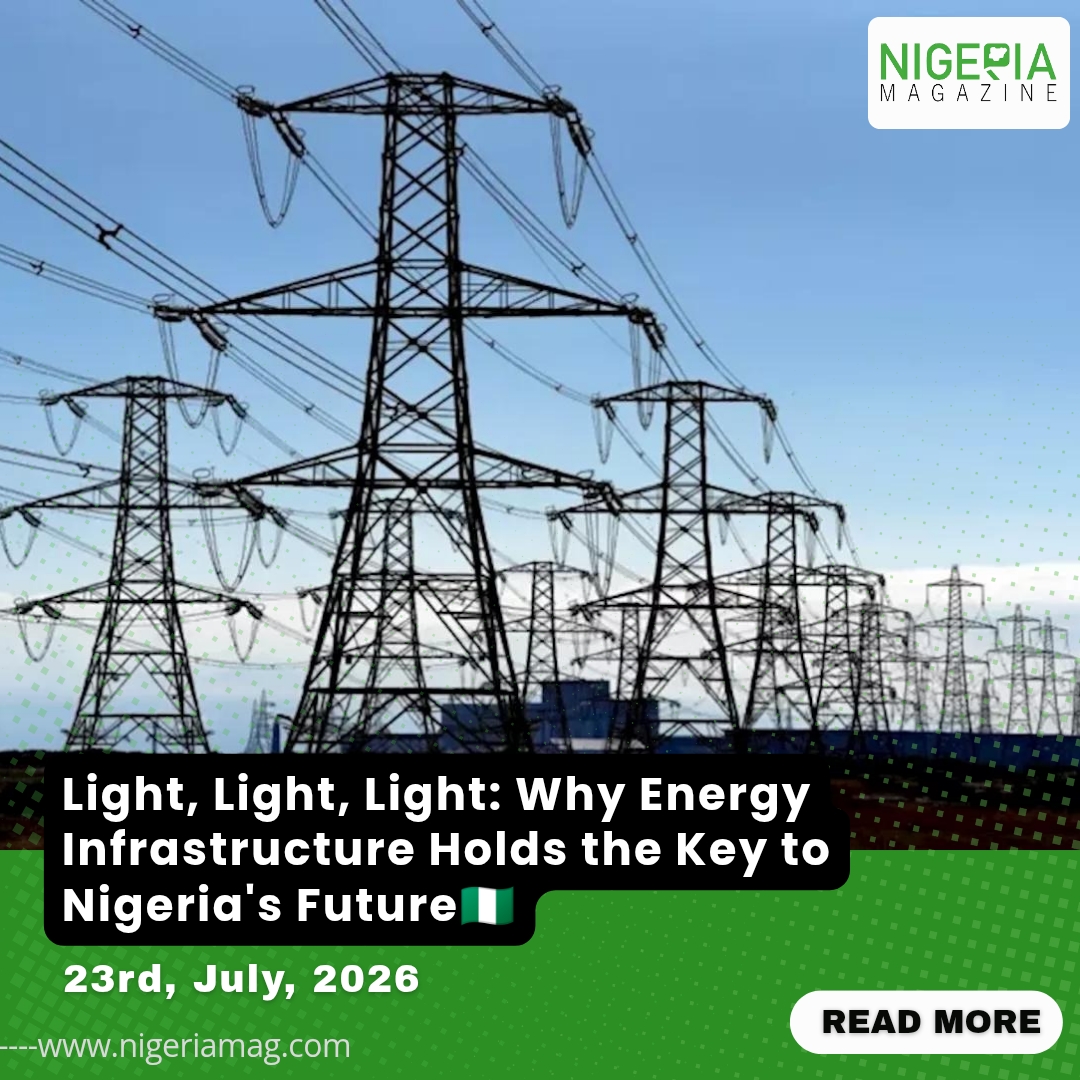
Light, Light, Light: Why Energy Infrastructure Holds the Key to Nigeria’s Future🇳🇬
By Moses Chibuike Ezechukwu
Electricity is more than just a convenience—it is the backbone of economic growth, quality healthcare, education, industrial development, and national progress. As Nigeria strives to become one of the world’s leading economies, strengthening its energy infrastructure has become an urgent national priority.
A Nation Waiting for the Switch
Ask any Nigerian what “light” means, and chances are the answer won’t be about illumination. It is about electricity—the kind that powers businesses, keeps hospitals running, allows students to study at night, and gives entrepreneurs the confidence to dream bigger.
For decades, electricity has remained one of Nigeria’s biggest development challenges. Despite abundant natural gas reserves, vast hydro resources, and some of the best solar potential in Africa, millions of Nigerians still experience unreliable electricity or have no access at all. The irony is difficult to ignore: a nation blessed with enormous energy resources continues to struggle with keeping the lights on.
Yet, amid the challenges lies an opportunity. Around the world, countries are proving that modern energy infrastructure can transform economies. Nigeria stands at a similar crossroads, where investments in transmission lines, renewable energy, smart grids, and decentralised power systems could redefine the country’s future.
Understanding Energy Infrastructure
Energy infrastructure refers to the physical systems that generate, transmit, distribute, and store electricity. It includes power plants, substations, transmission towers, distribution networks, transformers, and increasingly, renewable energy technologies such as solar farms, wind turbines, battery storage, and mini-grids.
Think of it as the circulatory system of a nation. Just as blood carries oxygen throughout the body, energy infrastructure delivers electricity to homes, schools, hospitals, farms, and factories. When that system is weak, every sector feels the impact.
Nigeria’s electricity value chain has expanded over the years, but aging equipment, insufficient investment, transmission bottlenecks, and distribution losses continue to limit reliable power delivery. Analysts have repeatedly noted that access to electricity remains uneven across regions, with rural communities facing the greatest challenges.
The Cost of Unreliable Electricity
Power shortages affect far more than household comfort. They directly influence economic productivity.
Small business owners spend huge portions of their income on diesel or petrol generators. Manufacturers face rising operational costs, making locally produced goods more expensive. Hospitals risk interruptions during life-saving procedures, while students lose valuable study time during frequent outages.
Digital businesses, which depend on uninterrupted internet connectivity and computing power, also bear significant costs. From tech startups in Lagos to tailoring shops in Aba and rice mills in Kebbi, unstable electricity quietly reduces productivity every single day.
According to development studies, limited electricity access slows poverty reduction, weakens industrial growth, and widens inequalities between urban and rural communities.
Why Nigeria Still Struggles
The country’s electricity challenge did not emerge overnight. It is the result of decades of underinvestment, aging infrastructure, rapid population growth, and governance challenges.
Nigeria generates more electricity than it is often able to efficiently transmit and distribute. Transmission infrastructure has struggled to keep pace with demand, while aging equipment contributes to frequent grid disturbances. Grid instability and inadequate maintenance have also resulted in repeated nationwide outages over the years.
Urban centres often receive relatively better supply, while many rural communities remain underserved. This imbalance has created what experts describe as an energy access gap that continues to affect millions of households.
Renewable Energy: Lighting New Paths
Fortunately, the story is beginning to change.
Renewable energy is gradually becoming one of Nigeria’s brightest opportunities. Solar energy, in particular, offers enormous promise because the country receives abundant sunshine throughout the year.
Instead of waiting for expensive national grid extensions, many communities are now benefiting from mini-grids and standalone solar systems that provide reliable electricity for homes, schools, healthcare centres, and businesses.
Several electrification initiatives have expanded access through solar-powered mini-grids, helping communities that had waited years for reliable electricity. These projects demonstrate that decentralised energy solutions can complement the national grid rather than replace it.
Beyond improving living standards, renewable energy is also creating employment opportunities for engineers, technicians, installers, and entrepreneurs.
Technology Is Changing the Energy Conversation
Modern energy infrastructure is no longer just about building bigger power stations.
Across the world, countries are investing in smart grids, digital metres, battery storage systems, and data-driven electricity management. These technologies reduce losses, improve billing transparency, detect faults more quickly, and enhance overall reliability.
Nigeria has already begun embracing prepaid metering and decentralised electricity models, but greater investment in digital infrastructure will be necessary to build a more resilient power sector.
As battery storage becomes more affordable, renewable energy systems will also become increasingly dependable, ensuring electricity remains available even when sunlight disappears.
The Role of Government and Private Investment
Energy infrastructure requires long-term planning and significant financial investment.
Government policies remain important for creating an enabling environment, but private investors also play a critical role. Stable regulations, transparent markets, and improved cost recovery can encourage investment in generation, transmission, and renewable projects.
Recent reforms and electrification programmes have sought to improve electricity distribution while expanding access through both grid and off-grid solutions. Development partners continue supporting projects that strengthen infrastructure and improve electricity services nationwide.
Ultimately, sustainable progress will depend on collaboration between government institutions, private companies, financial institutions, development organisations, and local communities.
What the Future Could Look Like
Imagine a Nigeria where manufacturers no longer rely heavily on generators.
Imagine hospitals operating without fear of sudden blackouts.
Imagine students in rural communities studying confidently after sunset.
Imagine farmers preserving produce through reliable cold storage powered by clean electricity.
These are not unrealistic dreams. They are achievable outcomes when countries invest consistently in modern energy infrastructure.
Around Africa, growing investment in renewable energy, mini-grids, and electricity access programmes is already transforming communities, improving education, healthcare, and economic opportunities. Nigeria possesses the resources, talent, and market size to become one of the continent’s leading energy success stories if infrastructure development remains a national priority.
More Than Just “Light”
For Nigerians, the word “light” has always carried emotional weight. It represents hope after darkness, productivity after interruption, and opportunity after limitation.
Strengthening energy infrastructure is not merely about increasing megawatts or constructing transmission lines. It is about empowering entrepreneurs, creating jobs, improving healthcare, strengthening education, attracting investment, and unlocking the country’s enormous economic potential.
Every switch that stays on tells a bigger story—a story of progress, resilience, and possibility.
If Nigeria is serious about building a prosperous future, then investing in reliable, modern, and sustainable energy infrastructure is no longer optional. It is the foundation upon which every other national ambition will stand.

