


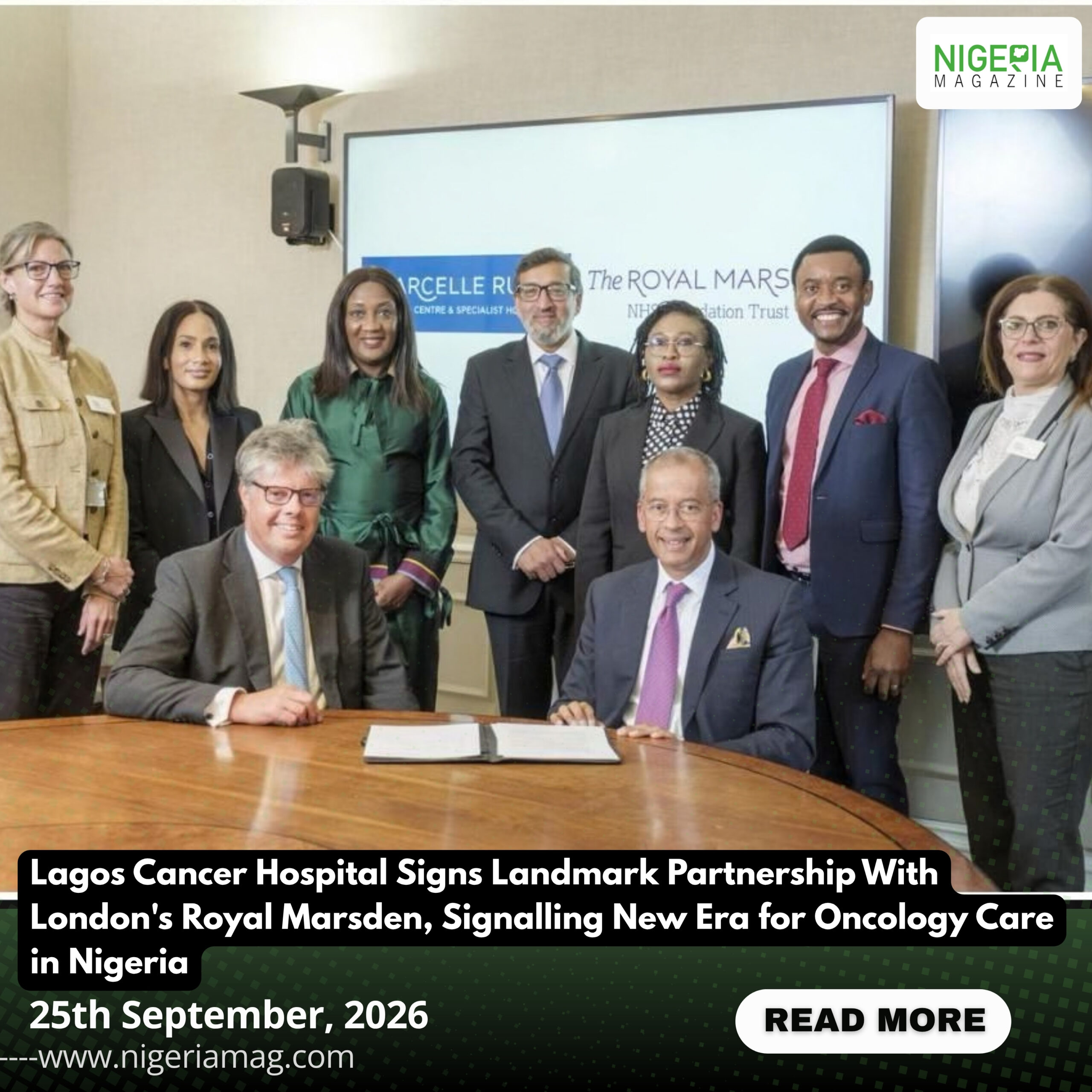
A Lagos-based specialist hospital has entered into a strategic partnership with one of the world’s most renowned cancer institutions, in a development set to reshape access to advanced oncology care across Nigeria and the wider West African region.
Marcelle Ruth Cancer Centre & Specialist Hospital (MRCC) has signed an agreement with The Royal Marsden NHS Foundation Trust, the London-based hospital widely regarded as one of the top cancer centres in the world. The partnership will focus on advanced clinical training, collaborative research, and the transfer of world-class oncology standards into Nigeria’s healthcare system.
Addressing the Cost of Medical Tourism
For years, Nigerians battling cancer have often had to travel abroad in search of specialist treatment, a reality that carries steep financial and emotional costs for patients and families. The MRCC-Royal Marsden alliance directly targets this problem, aiming to build local capacity so that world-class cancer care is available at home rather than overseas.
By embedding international clinical standards into MRCC’s operations, the partnership seeks to expand access to complex oncology services within Nigeria while retaining medical expertise in the region rather than losing it to outbound patient travel.
A Personal Full-Circle Moment
MRCC was founded in December 2020 by consultant haematologist Dr. Modupe Elebute-Odunsi and her husband, with a vision of ensuring no Nigerian would need to leave the country to access world-class oncology treatment.
Notably, Dr. Elebute-Odunsi completed part of her early specialist training at The Royal Marsden during the 1990s. She has described the new partnership as both a major institutional milestone and a deeply personal, full-circle achievement; coming full circle from trainee to founder of an institution now formally allied with the hospital that helped shape her career.
A Storied Institution
Founded in 1851, The Royal Marsden was the world’s first hospital dedicated solely to cancer diagnosis, treatment, research, and education. Today, alongside its research partner, the Institute of Cancer Research, it ranks among the top cancer centres globally for research impact, treating tens of thousands of patients from the UK and abroad each year.
Diplomatic Backing
The agreement carried notable diplomatic and commercial weight, reflecting deepening healthcare trade ties between Nigeria and the United Kingdom. The signing ceremony drew support from Ambassador Mercy Haruna-Adeoye of the Nigerian High Commission in the UK, representatives of the British High Commission in Nigeria, and officials from the UK Department for Business and Trade.
Beyond the ceremonial signing, the partnership is expected to translate into tangible outcomes for patients: shared scientific knowledge, joint research initiatives, and professional development opportunities for Nigerian clinicians; all aimed at strengthening the country’s cancer care infrastructure from within.
As Nigeria continues to grapple with a rising cancer burden and limited access to specialist treatment, partnerships of this kind may prove to be a model for how local institutions can bridge global expertise with domestic delivery.

