


By Moses Chibuike Ezechukwu
An in-depth look at the companies and executives shaping Nigeria’s share registration industry, their influence on the capital market, and why their work matters to investors, listed companies, and the wider economy.
The People Behind the Numbers on the Nigerian Stock Exchange
When people talk about Nigeria’s capital market, the conversation usually revolves around stock prices, dividends, company profits, market performance, and the fortunes of investors. However, behind these familiar aspects of investing is an important group of financial service providers whose work often receives far less public attention: share registrars.
These companies play a crucial role in connecting publicly listed businesses with their shareholders.
They maintain shareholder records, facilitate dividend payments, process changes in share ownership, and provide administrative services that help the capital market function effectively.
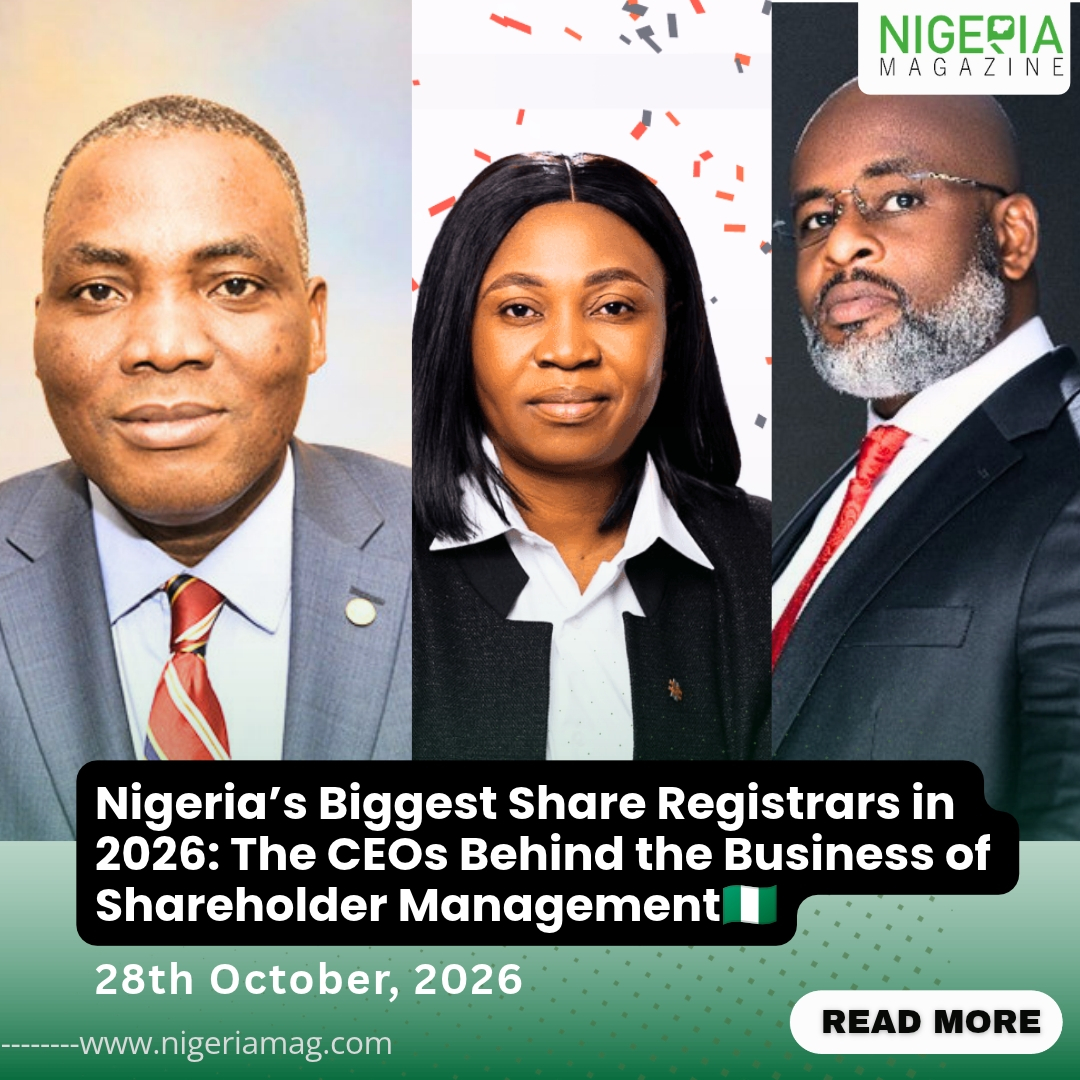
A report highlighting the chief executives of Nigeria’s largest share registrars in 2026 draws attention to the people leading this important part of the financial services industry. The executives represent firms such as Coronation Registrars, DataMax Registrars, Pace Registrars, Greenwich Registrars, First Registrars, Veritas Registrars, Meristem Registrars, CardinalStone Registrars, Africa Prudential, and other operators in the sector.
Beyond the names and photographs, the bigger story is about the structure of Nigeria’s share registration business, the concentration of market influence among a handful of firms, and the growing importance of efficient shareholder services in an increasingly digital financial environment.
Understanding the Role of Share Registrars
A share registrar is a financial services company responsible for maintaining accurate records of a company’s shareholders and managing various administrative processes associated with share ownership.
For example, when a company listed on the Nigerian Exchange (NGX) declares a dividend, the registrar helps identify eligible shareholders and facilitates the process of distributing the payment through the appropriate channels.
Registrars also maintain records of shareholdings, process shareholder information updates, support corporate actions, and respond to enquiries from investors seeking clarification about their investments.
Although these responsibilities may appear straightforward, they become considerably more demanding when a company has thousands or even millions of shareholders.
Accuracy is essential. A mistake in shareholder records or dividend processing can cause frustration, financial inconvenience, and a loss of confidence in the institutions responsible for managing investors’ interests.
This makes the registrar more than a record-keeping service provider. It is an important link in the chain of trust connecting companies, investors, and the broader capital market.
For investors, the quality of a registrar’s services can shape their experience long after they have purchased shares. For listed companies, the registrar’s performance can influence shareholder relations, corporate governance, and the smooth administration of important financial decisions.
The 2026 Landscape: A Few Firms Dominate the Market
One of the most interesting points in the report is the concentration of share registration services among a relatively small number of companies.
According to the analysis presented in the screenshot, 46 NGX-listed companies that generated more than ₦100 billion in revenue during the 2025 financial year were examined. The findings indicate that five registrar firms account for more than two-thirds of the companies in the sample.
This observation raises important questions about competition, market leadership, operational capacity, and the ability of smaller registrars to compete with established industry players.
On one hand, the concentration of major corporate clients among a few firms may reflect their experience, technological capabilities, established relationships, and ability to handle complex shareholder records. Large companies need service providers that can manage substantial volumes of information while maintaining accuracy, confidentiality, and operational reliability.
On the other hand, a concentrated market can create challenges. When a relatively small group of providers manages a significant proportion of major companies’ shareholder records, competition and service quality become particularly important.
However, the findings should be interpreted carefully. The analysis covers a specific sample of large, revenue-generating companies rather than the entire registrar industry. It does not, by itself, establish the market shares of individual firms or prove that smaller registrars are unable to compete.
Nevertheless, it offers a useful indication of how business relationships are distributed within an important segment of Nigeria’s capital market.
The bigger question is whether this concentration will encourage established firms to improve their services further or make it more difficult for new competitors to gain a foothold.
Meet the CEOs Leading Nigeria’s Share Registration Industry
The executives featured in the 2026 graphic represent several companies operating within Nigeria’s share registration and investor services sector.
Among them is Bridget Bayo Ajayi, CEO of Cordros Registrars, whose leadership places her among the executives responsible for managing shareholder services and supporting corporate clients.
Olufisola Folayan, Managing Director of DataMax Registrars, represents another firm operating in a sector where reliable record management and efficient service delivery are essential.
At Pace Registrars, Adeniji Tokunbo serves as Managing Director, while Anne Mutuah is identified as Acting Managing Director of Greenwich Registrars.
Other executives featured include Oluseyi Owoturo, MD/CEO of Coronation Registrars; Bayo Olugbemi, MD/CEO of First Registrars & Investor Services; and Ugo Okonkwo, MD of Veritas Registrars.
The graphic also identifies Nkechinche Okoye as MD of Meristem Registrars, Oluwaseyi Olulana as Acting Registrar of Atlas Registrars, Raymond Akokota as MD of CardinalStone Registrars, and Catherine Nwosu as MD/CEO of Africa Prudential Plc.
Together, these leaders illustrate the range of firms participating in Nigeria’s shareholder services market.
Their responsibilities extend beyond overseeing daily operations. They must also respond to changing regulatory expectations, maintain relationships with corporate clients, protect shareholder information, and ensure that their organisations remain competitive.
For these executives, success is not simply about attracting more listed companies. It is also about demonstrating that their firms can deliver accurate, dependable, and accessible services to the investors whose records they manage.
Note: The names and positions above are reproduced from the supplied graphic. Readers should consult the respective companies for confirmation of current appointments.
Technology Is Changing the Business
One of the biggest issues facing the registrar industry is digital transformation.
Investors increasingly expect to access information, update their records, make enquiries, and resolve dividend-related issues without unnecessary paperwork or repeated visits to physical offices.
This expectation is particularly important in Nigeria, where some investors may hold shares purchased many years ago and may need assistance updating their personal information or resolving outstanding dividend issues.
For registrars, technology presents both an opportunity and a responsibility.
Digital platforms can make shareholder services faster, reduce administrative costs, improve record accuracy, and provide investors with more convenient access to information. Automation can also help firms process large volumes of transactions more efficiently.
However, digitisation must be accompanied by strong cybersecurity measures, reliable systems, and appropriate safeguards for personal and financial information.
A digital platform that is difficult to use or frequently unavailable may create more frustration than convenience.
The firms that distinguish themselves in the coming years will likely be those that combine technological investment with responsive customer service. Investors want more than sophisticated systems; they want their questions answered and their problems resolved.
What This Means for Investors and Listed Companies
The registrar industry has implications for both individual shareholders and publicly listed businesses.
For investors, an efficient registrar can make it easier to maintain accurate records, receive dividend payments, and obtain information about their investments. Poor service, by contrast, can turn relatively simple administrative matters into prolonged disputes.
Investors should therefore understand which registrar manages the records of companies in which they hold shares and know the appropriate channels for submitting enquiries or updating their details.
For listed companies, choosing a registrar is an important administrative decision. The provider must be capable of handling shareholder records accurately, supporting corporate actions, maintaining confidentiality, and communicating effectively with investors.
The concentration highlighted in the report also suggests that established registrars have an opportunity to deepen their relationships with major corporate clients. However, retaining those relationships will require consistent performance rather than relying solely on reputation or existing contracts.
Ultimately, shareholders judge the system by its results: accurate records, accessible services, timely communication, and dependable administration.
Challenges and Opportunities Ahead
Despite its importance, the registrar industry faces several challenges.
First, maintaining accurate shareholder information can be difficult when investors change addresses, telephone numbers, bank details, or other personal information over time.
Second, digital transformation requires sustained investment in technology, staff training, cybersecurity, and customer support.
Third, competition may intensify as financial services companies seek to expand their offerings and strengthen relationships with corporate clients.
There is also an opportunity to improve investor education. Many people who own shares do not fully understand how registrars operate or where to turn when they encounter dividend or shareholder-record problems.
Better communication could help bridge this gap and improve confidence in the market.
For Nigeria, stronger registrar services can support wider efforts to encourage investment, deepen participation in the capital market, and improve the experience of shareholders.
Leadership Must Translate Into Better Service
The spotlight on Nigeria’s largest registrars in 2026 offers more than a list of executives. It provides an opportunity to examine the institutions that help keep the country’s capital market organised and accessible.
The concentration of major corporate clients among a relatively small group of firms highlights the importance of experience, operational capacity, competition, and technological readiness.
Yet leadership positions and corporate relationships alone do not define success. The real measure is whether these organisations can deliver reliable services to the companies they represent and the investors who depend on them.
As Nigeria’s financial sector evolves, share registrars will remain an important part of the investment process. Their ability to combine technology, transparency, operational efficiency, and responsive customer service will help determine how effectively they meet the needs of a changing market.
For the executives leading these firms, the challenge is clear: maintaining their position in the industry is important, but earning and sustaining investors’ trust is even more important.
For Nigeria’s capital market to grow stronger, the institutions working behind the scenes must perform just as effectively as the companies and investors in the spotlight.
#NigeriaMagazine #NigerianExchange #NGX #NigeriaCapitalMarket #ShareRegistrars #NigerianStockMarket #InvestmentInNigeria #FinancialServices #CorporateGovernance #DividendPayments #InvestorRelations #DigitalTransformation #NigerianEconomy #BusinessLeadership #FinanceInNigeria

