


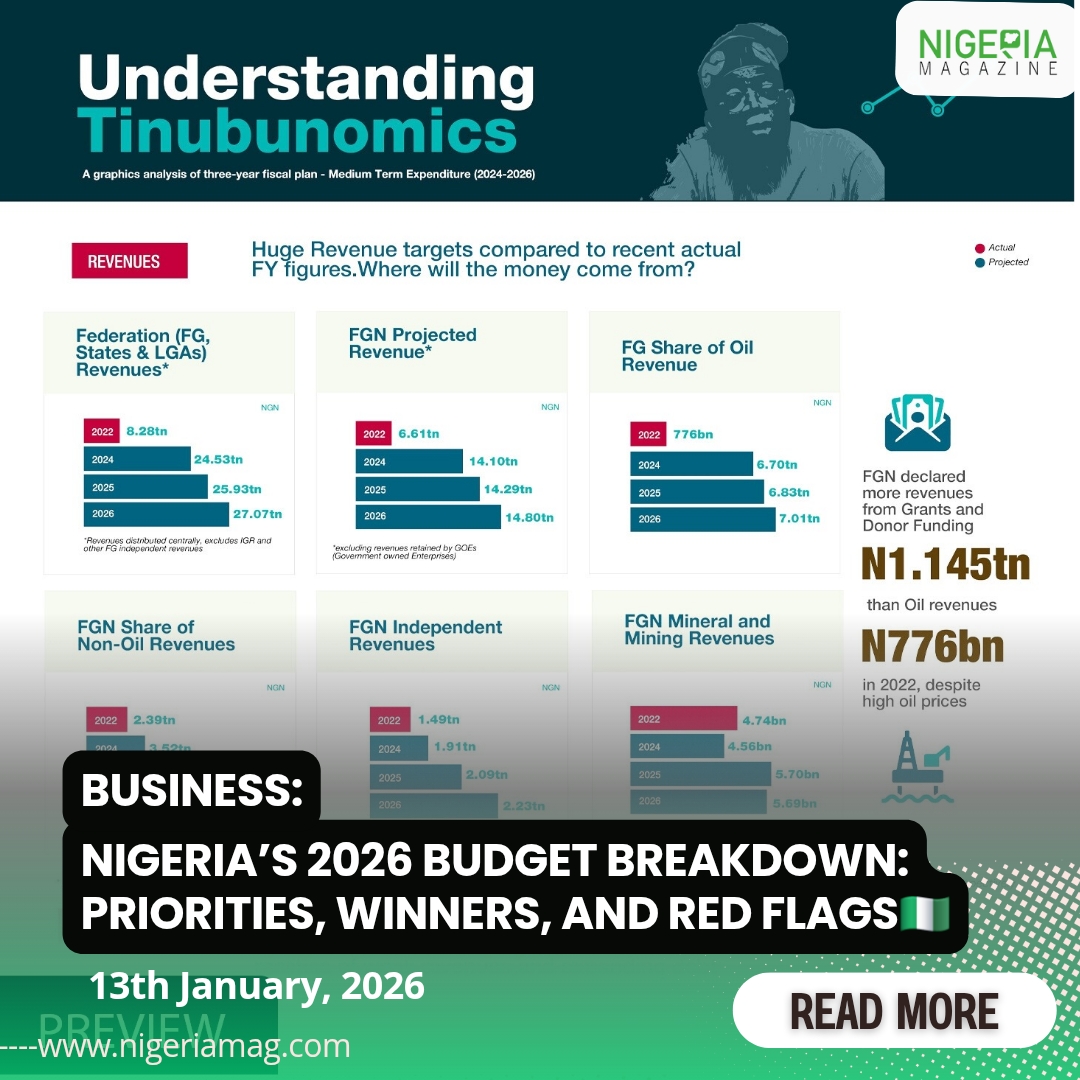
Nigeria’s 2026 federal budget, presented by President Bola Tinubu to the National Assembly in December 2025, marks a pivotal moment in the country’s fiscal policy. Titled the “Budget of Consolidation, Renewed Resilience and Shared Prosperity,” the ₦58.18 trillion plan is built around ambitious economic goals amid lingering macroeconomic pressures, a historically large deficit, and pressing development needs. This deep dive examines the government’s revenue assumptions, spending priorities, key winners, and the potential red flags that could shape Nigeria’s economic trajectory in 2026. (statehouse.gov.ng)
Fiscal Framework: Revenue Assumptions and Deficit Dynamics
At the core of the 2026 budget are conservative macroeconomic assumptions designed to anchor fiscal planning:
Crude oil benchmark: US$64.85 per barrel
Oil production: 1.84 million barrels per day
Exchange rate: ₦1,400 to the US dollar
GDP growth: Cited at nearly 4% in Q3 2025, signalling modest recovery gains. (ndr.org.ng)
The government projects total revenue of ₦34.33 trillion, a figure that reflects expanded non‑oil receipts but remains significantly below projected expenditures of ₦58.18 trillion. This leaves a budget deficit of ₦23.85 trillion, equivalent to about 4.28% of GDP — one of the largest in Nigeria’s history. (ndr.org.ng)
Debt servicing alone is slated to consume ₦15.52 trillion, more than many critical development sectors combined. Analysts and business groups, such as the Lagos Chamber of Commerce and Industry (LCCI), have raised concerns that the prioritisation of debt repayment may crowd out investment in productive sectors. (aljazirahnews.com)
To bridge financing gaps, the government plans significant borrowing. According to the budget framework, new borrowing could reach as high as ~₦17.9 trillion, with domestic sources accounting for the bulk, heightening the risk of crowding out private sector credit. (inquirer.ng)
Spending Priorities: Who Wins in 2026?
- Security and Defence – The Biggest Slice
By far the largest allocation in the budget is for defence and security — ₦5.41 trillion. The government’s heavy investment reflects the priority placed on counter‑terrorism, border security, and stabilisation across conflict‑affected regions. Tinubu’s address explicitly framed insecurity as a major impediment to economic growth and foreign investment. (ndr.org.ng)
Security spending is expected to support enhanced intelligence‑led policing, military modernisation, and coordinated national counter‑insurgency campaigns. This marked emphasis indicates a fiscal commitment to stabilising the domestic environment, even as analysts worry about measuring the impact of past security expenditures. (techeconomy.ng)
- Infrastructure – Sustaining Connectivity and Growth
Infrastructure received ₦3.56 trillion, making it one of the top recipients of budget funds. This reflects ongoing efforts to plug critical gaps in roads, power, and ports that underpin private sector growth.
Previous capital projects will continue to absorb resources, with an emphasis on completing existing initiatives rather than launching large new ones — a shift many analysts see as pragmatic given tight fiscal space.
- Human Capital – Education and Health
Education and health receive ₦3.52 trillion and ₦2.48 trillion, respectively. These allocations signal continued support for human capital, though they fall short of international benchmarks recommended to achieve Sustainable Development Goals and meet demographic needs. (nigeria.actionaid.org)
Education investments are intended to support expanded access and quality improvements, while health allocations focus on strengthening primary healthcare and improving service delivery. However, relative to the size of the budget, these sectors are often viewed as underfunded, raising concerns among civil society and development advocates. (nigeria.actionaid.org)
- Agriculture and Economic Diversification
While not among the top headline allocations, agriculture and initiatives intended to broaden the economic base are expected to be supported through capital spending and targeted programmes meant to spur food security, job creation, and export‑oriented growth.
Red Flags: Risks Within the Numbers
Despite ambitious goals, several concerns loom large:
- Ballooning Deficit and Debt Burden
With the deficit approaching historic highs and debt servicing eating into a large share of total revenue, long‑term sustainability remains in question. Critics argue that unless non‑oil revenues grow significantly, the government may face structural financing challenges that elevate inflation and weaken fiscal credibility. (inquirer.ng)
The heavy tilt toward domestic borrowing — around 80% of projected new debt — may also place upward pressure on interest rates, potentially crowding out private investment. (inquirer.ng)
- Unrealistic Revenue Projections
Several commentators have questioned the realism of revenue forecasts. Historical patterns of underperformance against projections in past budgets have fuelled skepticism that the government may again fall short, especially in oil and non‑oil tax receipts. (nigeria.actionaid.org)
If revenues fail to match projections, the deficit could widen further, creating pressure for either deeper borrowing or cuts to planned expenditures.
- Social Sector Underfunding
Despite rhetoric about human capital development, allocations to health and education combined still represent a modest share of total spending, raising concerns about the government’s capacity to deliver meaningful improvements in these sectors. ActionAid Nigeria has flagged these allocations as below global benchmarks, which could undermine long‑term socio‑economic gains. (nigeria.actionaid.org)
- Implementation Risks and Institutional Capacity
The president’s speech stressed stronger discipline and better execution, but Nigeria’s budget implementation has historically faced delays, overlapping projects, and unspent capital allocations. Failure to resolve these issues could dilute the impact of the 2026 budget’s priorities. (statehouse.gov.ng)
A Budget at a Crossroads
Nigeria’s 2026 budget embodies a delicate balancing act: pursuing security and stability, nurturing human capital, and managing a complex debt profile amid limited revenues. While allocations reflect the government’s stated priorities, several risks — notably high borrowing requirements, revenue shortfalls, and underfunded social sectors — underscore the need for rigorous implementation and broader economic reforms.
In many ways, the 2026 budget is a test of Nigeria’s fiscal resilience. If executed effectively, it could consolidate recent macroeconomic gains and lay groundwork for growth. If key assumptions falter, the nation may confront renewed economic strain and social discontent.
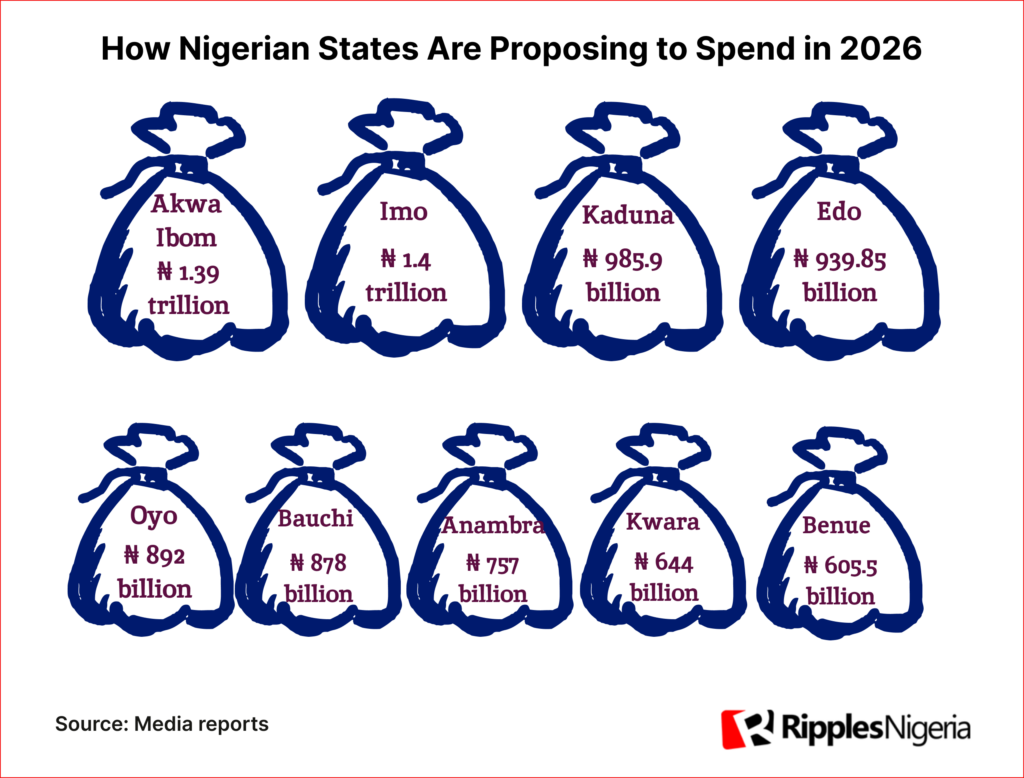
Only time will tell whether the promises embedded in this budget translate into tangible improvements for Nigerians across states, sectors, and socio‑economic classes.

