


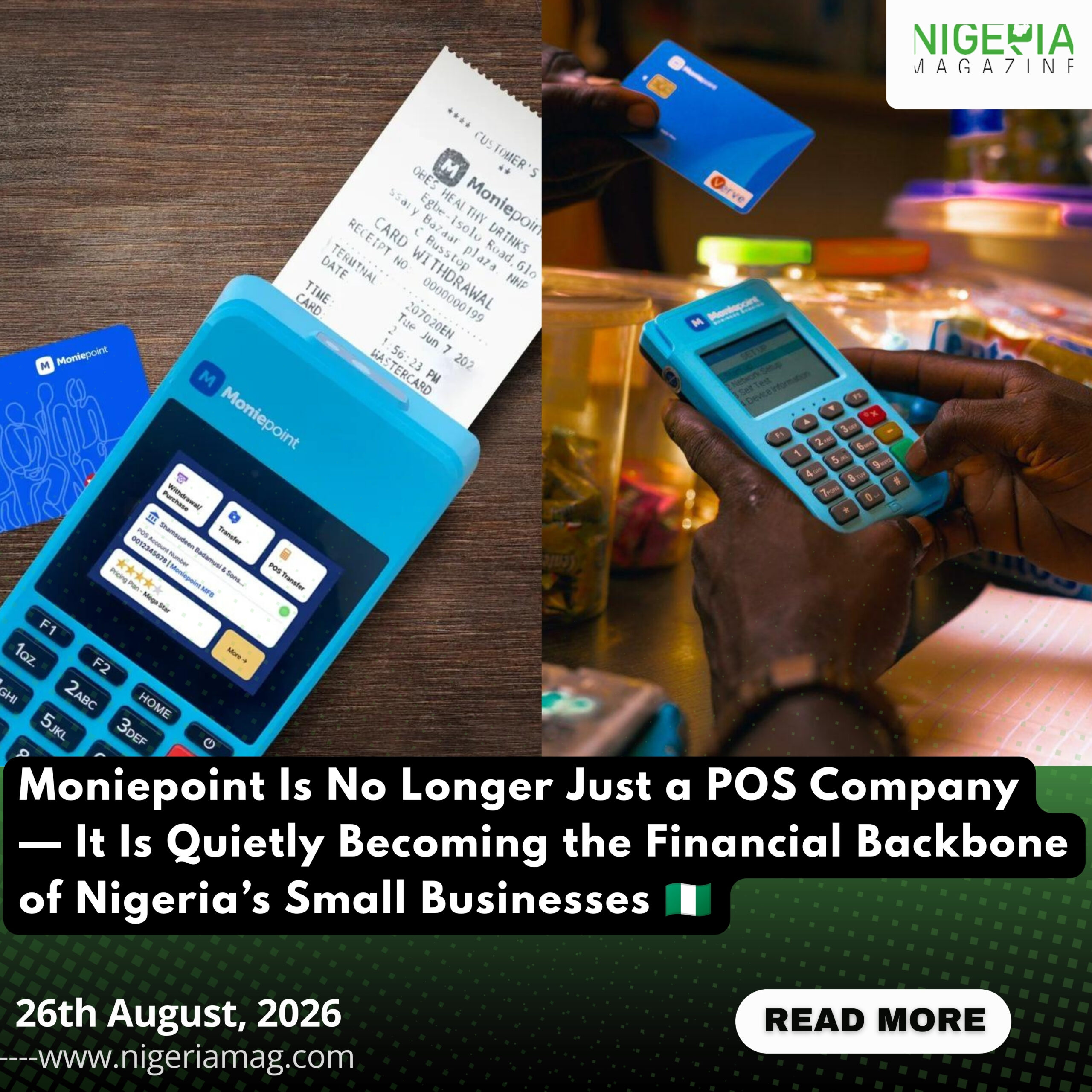
by Moses Chibuike EzechukwuFrom the familiar POS terminal on the corner to business banking, credit, payments and financial management, Moniepoint is building something much bigger — an ecosystem designed around the everyday Nigerian entrepreneur.There was a time when mentioning Moniepoint in Nigeria immediately brought one image to mind: a POS terminal sitting on the counter of a roadside shop.For many Nigerians, that was the introduction. You could walk into a small provision store, pharmacy, restaurant or POS stand, make a transfer or withdraw cash, and chances were high that the machine handling the transaction carried the Moniepoint name.But that picture is becoming outdated.Moniepoint is no longer simply a company that puts POS machines in the hands of small businesses. It is steadily positioning itself as something much more important: a financial platform sitting underneath the daily operations of millions of Nigerian businesses.And that shift may be one of the more interesting stories happening in Nigeria’s financial technology industry.It Started With Payments, But Payments Were Only the BeginningThe genius of the POS business was never really the machine itself. The machine was simply the doorway.
Once a company becomes the platform through which a business receives money every day, it gains something extremely valuable: an understanding of how that business operates.A shop owner who receives customer payments through a Moniepoint terminal is not just using a payment device. Over time, the platform can become part of the business’s financial routine — receiving money, settling transactions and helping the owner keep track of activity.
That creates an opportunity to offer much more than payments.Today, Moniepoint’s business offering includes business accounts, POS terminals, expense cards, working-capital loans, savings and business-management tools such as Moniebook. Its Nigerian business platform says more than 5 million business owners use the platform.
That is a very different proposition from simply selling POS terminals.The Small Business Owner Is the Real CustomerNigeria’s economy is full of businesses that may never make the headlines.There is the woman selling food from a small shop. The man running a building-materials store. The pharmacist trying to keep inventory moving. The fashion entrepreneur receiving payments from customers on social media. The supermarket owner managing several employees.
For these businesses, banking is not an abstract concept.It is about whether today’s sales arrive successfully. Whether there is enough money to restock tomorrow. Whether a supplier can be paid quickly. Whether a business can access credit when an unexpected opportunity appears.This is where Moniepoint’s strategy becomes particularly interesting.
Instead of treating payments, banking and credit as completely separate products, the company is bringing them together.Its business account allows merchants to receive and send money, pay bills and manage their business finances, while its credit products are designed to provide working capital.In simple terms, Moniepoint is trying to become the financial operating system for the small business.
Credit Could Be the Biggest Part of the StoryFor many small businesses in Nigeria, access to affordable and timely credit remains one of the biggest challenges.Traditional lending can be difficult when a business owner does not have extensive financial statements, formal assets or the kind of documentation that conventional lenders usually expect.
But digital financial platforms have another advantage: transaction data.A business that consistently receives payments through a digital platform creates a record of its activity. That information can potentially help lenders understand the business beyond what is written on a loan application.Moniepoint has openly embraced this approach.
In 2025, the company said its microfinance bank disbursed more than ₦1 trillion in credit to thousands of businesses. It also reported that businesses accessing the credit experienced average growth of more than 36 percent.More recently, Moniepoint said it disbursed more than $700 million in loans to MSMEs during 2025 as part of its wider financial-inclusion efforts.That changes the conversation.The POS terminal brings the merchant into the ecosystem. The business account keeps the money moving. Transaction activity provides financial visibility. Credit can then help the business grow.Suddenly, the POS machine looks less like the product and more like the entrance.From Informal Business to Formal BusinessAnother interesting part of Moniepoint’s strategy is its relationship with Nigeria’s enormous informal economy.
A large number of Nigerian businesses operate without the formal structures associated with larger companies. Yet they employ people, sell products, generate income and contribute significantly to the economy.
Moniepoint has been trying to bridge that gap.The company launched a business-registration service in partnership with Nigeria’s Corporate Affairs Commission, allowing business owners to register their businesses through its platform.That may sound like a small feature, but it represents a bigger idea.A business could potentially start with a simple payment solution and gradually move towards having a registered business, a dedicated business account, access to credit and tools for managing its finances.That is much closer to building an entire business ecosystem than simply providing a POS terminal.
The Numbers Tell Their Own StoryThe scale is difficult to ignore.Moniepoint says its platform serves more than 20 million businesses and individuals across Africa, while its Nigerian operations provide banking, credit and business-management tools to millions of users. The company also describes itself as Nigeria’s largest merchant acquirer and says its infrastructure processes a substantial share of the country’s POS transactions.
In October 2024, Moniepoint raised $110 million in a funding round backed by investors including Google’s Africa Investment Fund, pushing its valuation above $1 billion and making it one of Nigeria’s fintech unicorns. Reuters reported at the time that the company was processing more than 800 million transactions monthly.Those numbers matter because financial infrastructure becomes more powerful as more people use it.The more merchants accept payments through the network, the more useful the network becomes. The more businesses maintain accounts, the more financial services can potentially be built around them.That is the flywheel Moniepoint appears to be building.
But Becoming the Backbone Comes With ResponsibilityThere is, however, another side to this story.When a financial platform becomes deeply embedded in the daily lives of businesses, reliability becomes extremely important.A POS failure is not merely a technical inconvenience for a small merchant. If customers cannot pay, the business can lose sales. If money is delayed, a supplier may not be paid. If an account becomes inaccessible, the consequences can quickly become serious.This means that the bigger Moniepoint becomes, the higher the expectations will be.Trust, cybersecurity, customer support, transaction reliability and responsible lending will matter just as much as growth.Moniepoint says its POS terminals offer instant settlement and close to 100 percent transaction reliability, while its banking services are backed by a CBN-regulated microfinance bank whose deposits are insured by the NDIC.
For a company increasingly positioned at the centre of small-business finances, those fundamentals are not optional. They are the foundation.
The Bigger PicturePerhaps the most interesting thing about Moniepoint is that its transformation is happening quietly.There was no single morning when Nigeria woke up and declared that Moniepoint had become a major financial institution for small businesses.
It happened gradually.First came payments. Then banking. Then credit. Then business management. Then services designed to help businesses formalise and grow.Each individual product makes sense on its own.
Put together, however, they reveal a much bigger strategy.Moniepoint is trying to build the financial infrastructure around the Nigerian entrepreneur — from the moment a customer makes a payment to the moment a business needs a loan, manages expenses, saves money or expands.That is why calling Moniepoint merely a “POS company” increasingly misses the point.The POS terminal may have introduced Moniepoint to millions of Nigerians. But the bigger ambition appears to be keeping those businesses financially connected long after the transaction is completed.And if that strategy succeeds, the most important thing Moniepoint built may not be the machines Nigerians see on shop counters. It may be the financial ecosystem quietly operating behind them.

