


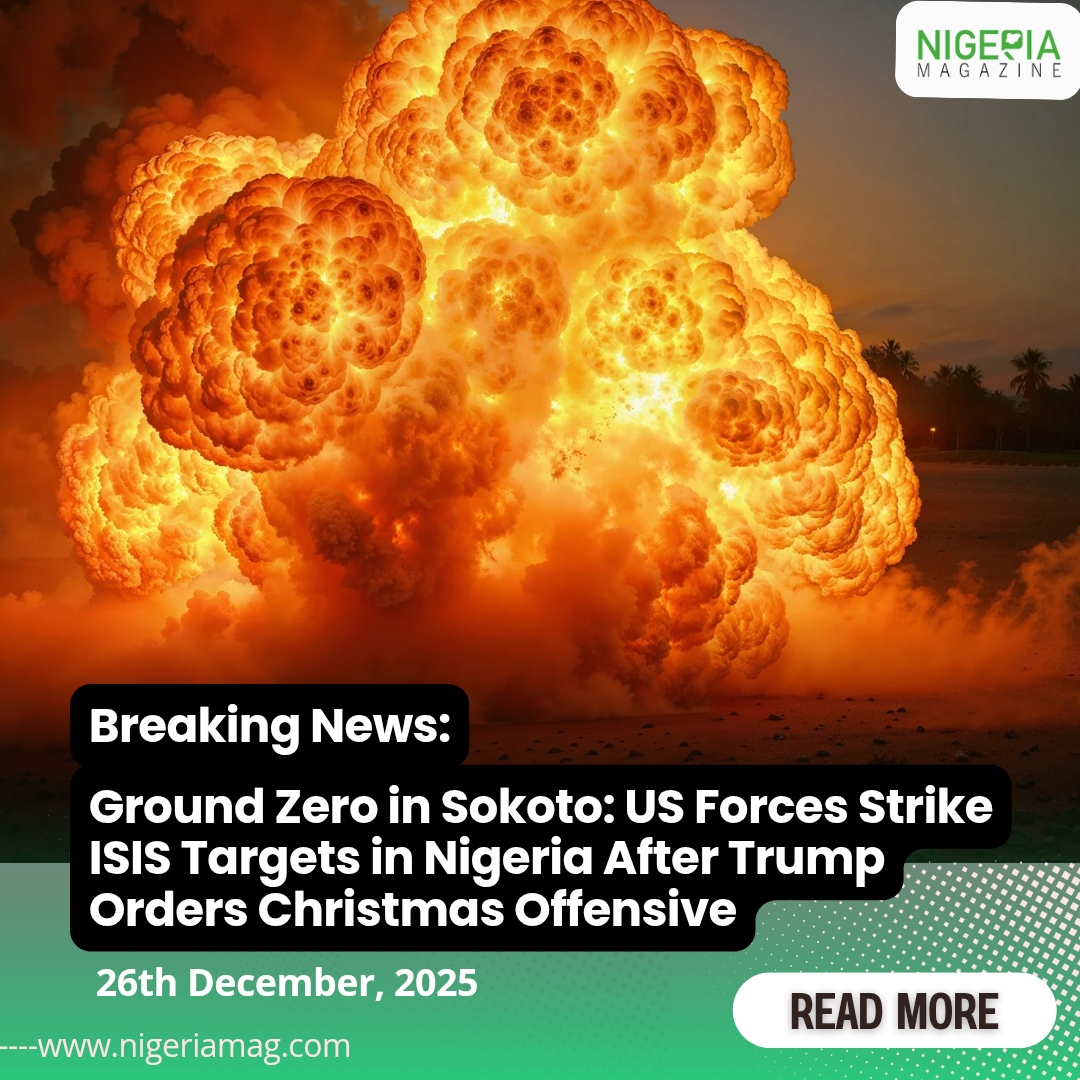
In a major and controversial development on the global stage, the United States military has carried out air strikes against Islamic State (ISIS) militants in northwest Nigeria, marking a rare instance of direct U.S. military action on Nigerian soil. The operation — announced by U.S. President Donald Trump on Christmas Day — targeted extremist camps in Sokoto State, in coordination with Nigerian authorities, and has reignited discussions about Nigeria’s complex internal security challenges and international cooperation against terrorism.
President Trump took to his social media platform on December 25, 2025, confirming that he directed a “powerful and deadly strike” against ISIS militants whom he accused of targeting and killing innocent Christians across Nigeria. According to his statement, the offensive was intended both to cripple militant strongholds and send a message that violent extremist groups would not go unchallenged.
U.S. Africa Command (AFRICOM) confirmed the strikes were carried out in Sokoto State, a northwest region bordering Niger, killing several Islamic State fighters. Initially, AFRICOM posted that the action was conducted at the request of the Nigerian government. Though that specific post was later removed, officials reiterated that the operation involved intelligence sharing and strategic coordination between the U.S. and Nigeria.
The Nigerian Ministry of Foreign Affairs has publicly acknowledged the joint action, framing it as part of ongoing security cooperation to counter violent extremist groups. In official comments, Abuja stressed that such collaboration reflects a mutual commitment to tackle terrorism and protect regional stability under international law.
However, the U.S. assertion that the strikes were primarily a response to attacks on Christians has stirred debate. Nigerian officials and analysts insist that armed group violence in the country affects both Muslim and Christian communities, pointing to the multifaceted nature of insurgent attacks that include religious, communal, and resource-driven conflicts. President Bola Ahmed Tinubu has consistently emphasised Nigeria’s commitment to upholding the rights of all citizens, regardless of faith, even as insecurity persists.
The Christmas Day operation represents a deepening of U.S. involvement in Nigeria’s security landscape — coming amid ongoing threats from entities such as the Islamic State West Africa Province (ISWAP) and Boko Haram. Security experts warn that while foreign support can bolster Nigeria’s counter-terrorism efforts, sustainable peace will depend on stronger domestic responses and effective governance across the nation’s troubled northern regions.
As Nigerians and international observers absorb this dramatic escalation, questions remain about the long-term implications of foreign military strikes on Nigerian soil — especially regarding sovereignty, religious tensions, and the future direction of Africa’s fight against violent extremism.

