


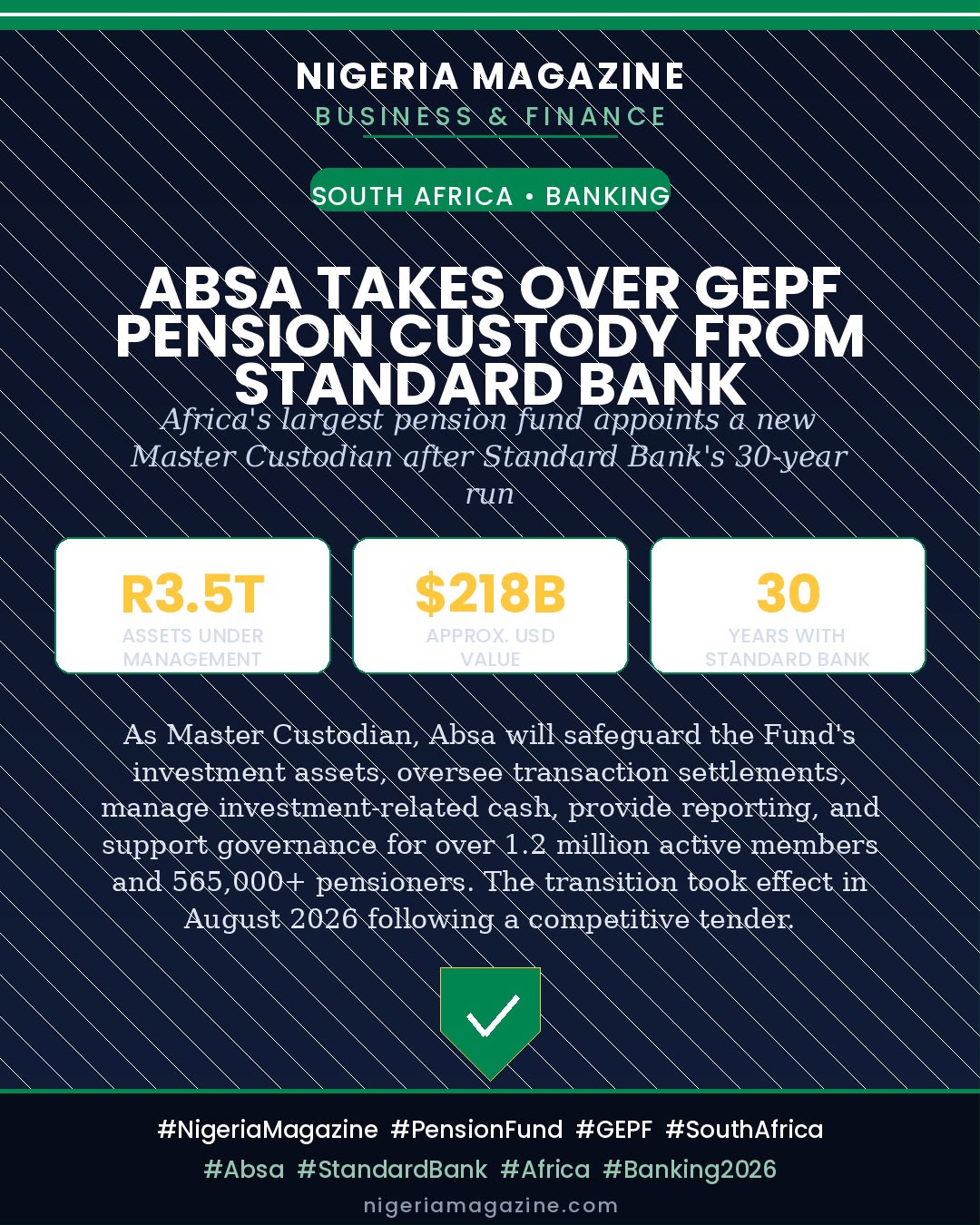
Absa Group has officially become the Master Custodian of South Africa’s Government Employees’ Pension Fund (GEPF), taking over from Standard Bank Group after three decades in the role. The handover, effective August 2026, follows a competitive tender process and marks one of the most significant custody mandate changes in South Africa’s institutional investment history. Africa’s Largest Pension FundThe #GEPF is widely regarded as Africa’s largest pension fund, with assets exceeding R3.5 trillion (roughly $218 billion). The fund serves more than 1.2 million active government employees along with over 565,000 pensioners and beneficiaries, making it a cornerstone of South Africa’s public-sector retirement system.Standard Bank had served as the GEPF’s custodian since the fund’s establishment in 1996, a relationship that spanned 30 years before this transition.
What Absa’s New Role InvolvesAs Master Custodian, Absa will now be responsible for: ▶️Safeguarding the GEPF’s investment assets.
▶️Overseeing settlement of investment transactions.
▶️Managing investment-related cash.
▶️Providing reporting services to support fund oversight.
▶️Coordinating broader custody functions across the fund’s investment ecosystem.
▶️Supporting the fund’s governance requirements.
Absa noted that it has maintained a transactional banking relationship with the GEPF since 2001, so this new mandate builds on an existing partnership rather than starting from scratch. Why It MattersWhile custody functions largely operate behind the scenes, they are foundational to keeping a pension fund of this scale running smoothly and transparently. Officials from Absa have described the appointment as a major responsibility, given the fund’s role in supporting public servants and their families across South Africa. Importantly, both Absa and the GEPF have indicated that this change is primarily institutional and operational — everyday members and pensioners are not expected to see any disruption to their benefits or services as a result of the switch.The move also reflects broader shifts in South Africa’s banking sector, as Absa continues to expand its footprint in transactional banking and large-scale institutional mandates on the continent.

