


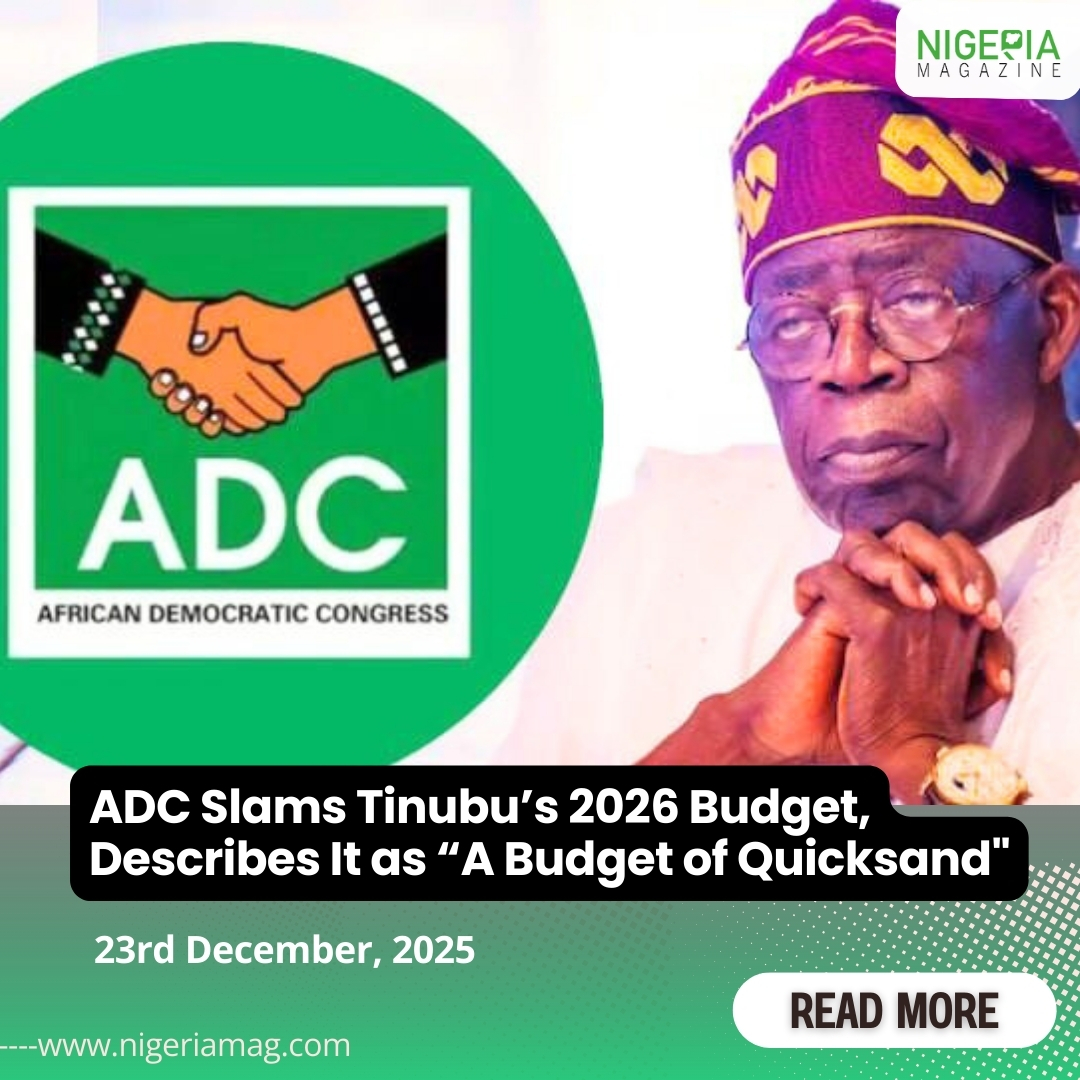
The African Democratic Congress (ADC) has strongly criticised the 2026 Appropriation Bill presented by President Bola Ahmed Tinubu, describing it as a fiscally reckless document built on unsustainable debt and unrealistic revenue projections.
Speaking to Nigeria Magazine correspondent, Ubong Usoro, the party’s National Publicity Secretary, Mallam Bolaji Abdullahi, said the 2026 budget, tagged “Budget of Consolidation, Renewed Resilience and Shared Prosperity,” is instead a consolidation of fiscal irresponsibility that will deepen economic hardship for Nigerians if passed without major amendments.
Abdullahi said the budget proposal merely replicates the structure of the 2024 and 2025 budgets, which he described as poorly implemented and largely deferred, raising fears that the 2026 budget may suffer a similar fate.
He criticised the timing of the proposal, noting that the federal government is introducing a new fiscal framework when the 2025 budget was only recently repealed and reenacted, a development he described as evidence of fiscal chaos and administrative incompetence.
According to him, Nigeria is already trapped in a severe fiscal crisis, but the Tinubu administration has continued to rely on excessive borrowing rather than confronting structural weaknesses in public finance. He warned that the growing debt burden is mortgaging the future of younger Nigerians while masking deep economic problems.
Abdullahi further faulted the federal government for what he described as its inability to properly close out previous budget cycles, stating that the simultaneous implementation of multiple national budgets is unprecedented in Nigeria’s fiscal history.
He also questioned the credibility of the government’s revenue projections, noting the sharp rise from ₦20 trillion in 2024 to ₦40 trillion in 2025, and now ₦58.57 trillion in 2026.
According to him, these figures are disconnected from economic reality and driven more by currency devaluation than real productivity growth.
On oil revenue, Abdullahi expressed concern over the $64 per barrel benchmark adopted by the federal government, warning that weakening global oil prices and easing geopolitical tensions could expose the economy to further shocks.
He described the plan to generate ₦34 trillion in revenue while borrowing ₦24 trillion as fiscally dangerous, noting that a deficit-to-revenue ratio of about 70 percent amounts to an admission of fiscal insolvency.
Abdullahi also raised concerns about capital expenditure, stating that while the government plans to spend ₦25.68 trillion on infrastructure, the projected deficit of ₦23.85 trillion means that most projects will be financed through borrowing.
He further highlighted the rise in debt servicing costs from ₦12.63 trillion in 2024 to a projected ₦15.52 trillion in 2026, arguing that such a trend is unsustainable.
He concluded by saying that Nigeria urgently needs a new fiscal direction built on discipline, credibility, and transparency, warning that the current path prioritises creditors over the welfare of the Nigerian people.
Ubong Usoro for Nigeria Magazine

