


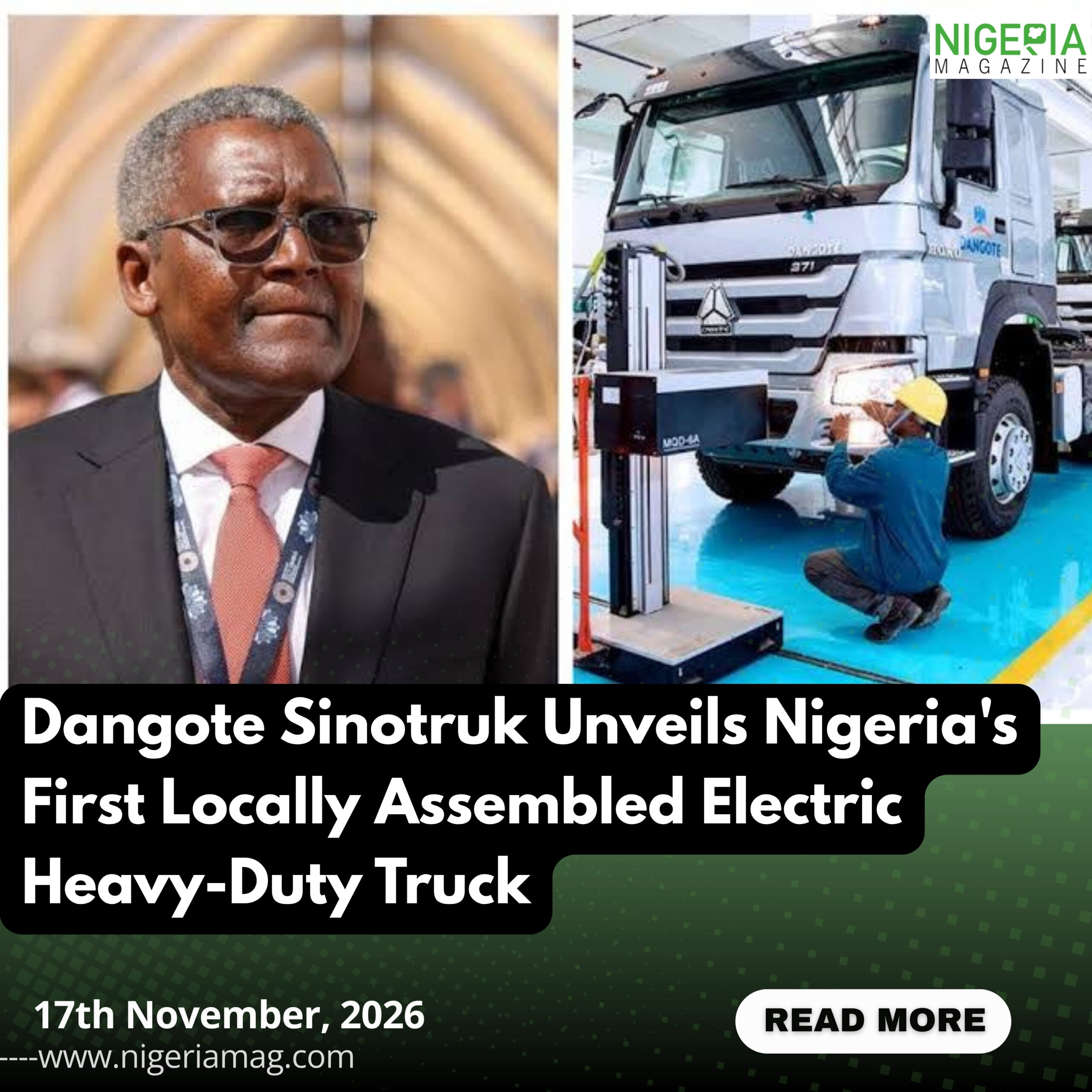
Dangote Sinotruk West Africa Limited has unveiled what it describes as Nigeria’s first locally assembled electric heavy-duty truck, taking its joint venture beyond conventional commercial vehicles and into electric mobility.
The truck was presented on Sunday, 15 November 2026, at the company’s assembly plant in Ikeja, Lagos. Representatives of the Dangote Group, Sinotruk Group and the Lagos State Government attended, along with industry stakeholders, customers and business partners. Speaking at the event, a Sinotruk representative described it as the official roll-off of the first electric heavy-duty truck from the joint venture. The Dangote Group called it a historic milestone for Nigeria’s automotive industry.
The launch follows the venture’s earlier focus on compressed natural gas (CNG) trucks. Devakumar Edwin said the joint venture had already moved into CNG technology and was now entering electric technology. He added that the group evaluated several Chinese manufacturers before choosing Sinotruk as its technology partner. He also said the company is preparing the infrastructure and technical support needed to deploy electric commercial vehicles effectively in Nigeria.
Sinotruk Group says the vehicle is the first new-energy truck assembled on the African continent. That claim comes from the company and has not been independently confirmed. What the unveiling does show is that a more sophisticated class of commercial vehicle is now being assembled in Nigeria.
The Lagos State Government welcomed the development. Reports also suggest it could open opportunities for Nigerian technicians, engineers and automotive component suppliers as electric vehicle technology expands. The company frames the project as part of a wider push towards green mobility, local manufacturing and sustainable transport across Nigeria and West Africa.
Key questions remain, including pricing, charging infrastructure and how quickly fleet operators will adopt electric trucks. For now, the rollout signals that Nigeria’s commercial vehicle industry is preparing for a shift beyond diesel and gas.

