


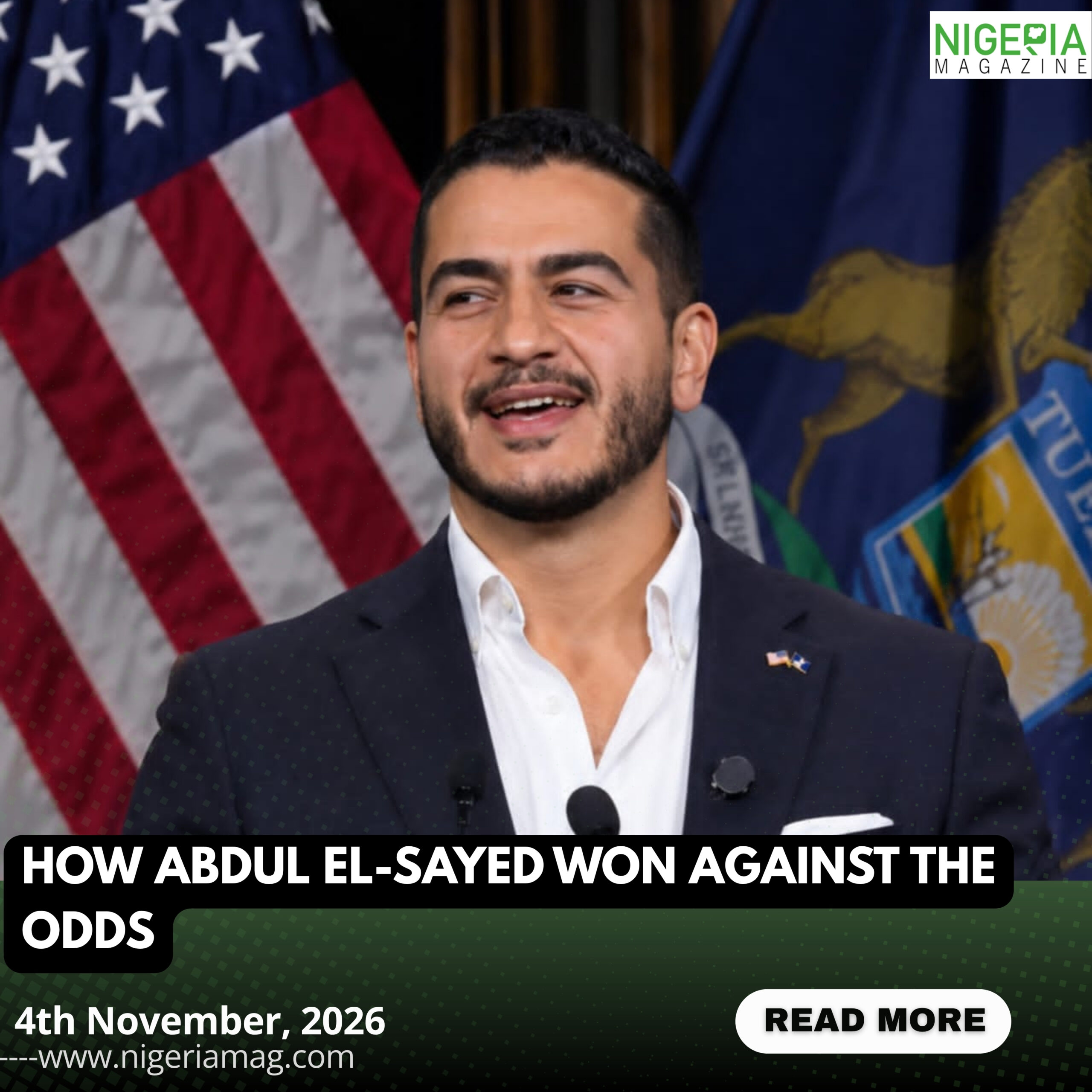
In politics, money, party structures and powerful endorsements often determine who gets the opportunity to compete. But Abdul El-Sayed’s victory in Michigan’s November 3, 2026 United States Senate election offers a different perspective on the power of grassroots politics.
El-Sayed defeated Republican Mike Rogers, securing 52.4 per cent of the vote against Rogers’ 45.6 per cent, according to Associated Press projections. His victory is historic, making him the first Muslim elected to the United States Senate. He is also the son of Egyptian immigrants.
However, his journey was far from straightforward.
Before facing the Republicans, El-Sayed had to overcome resistance within his own Democratic Party. In the August 2026 primary, he defeated Congresswoman Haley Stevens despite facing substantial financial opposition and the backing of influential establishment figures.
His campaign focused on issues affecting ordinary Americans, including affordable healthcare, housing, economic inequality and reducing the influence of wealthy donors in politics.
He also received support from progressive political figures, including Senator Bernie Sanders and Congresswoman Alexandria Ocasio-Cortez.
His positions on Israel and Palestine attracted criticism, while President Donald Trump also attacked his political identity and background. Nevertheless, El-Sayed maintained his campaign message and built support among voters seeking an alternative political direction.
One significant moment came when his former primary opponent, Haley Stevens, endorsed Republican Mike Rogers shortly before the general election. Rather than weakening his campaign, the controversy reportedly triggered a surge in donations from supporters.
His eventual victory demonstrates that political influence is not determined exclusively by financial resources or established party connections.
For Nigeria, particularly as political parties prepare for the 2027 general elections, El-Sayed’s emergence offers an important lesson about grassroots mobilisation, political messaging and public trust.
Nigeria’s political environment is dominated by established parties with extensive structures, financial resources and influential political networks. New political movements often struggle to compete within this environment.
However, El-Sayed’s experience shows why political parties must look beyond personalities and campaign spending. They must develop policies that address the everyday concerns of citizens, build credible grassroots structures and give voters reasons to believe in their political vision.
His victory does not mean that money and political structures are irrelevant. Rather, it demonstrates that they do not automatically guarantee electoral success.
Ultimately, Abdul El-Sayed’s story is a reminder that political establishments can be challenged when citizens find a candidate whose message resonates with their expectations.
For Nigeria, the question ahead of 2027 is whether emerging political movements can translate public dissatisfaction into credible political alternatives.
Ubong Usoro for Nigeria Magazine

