


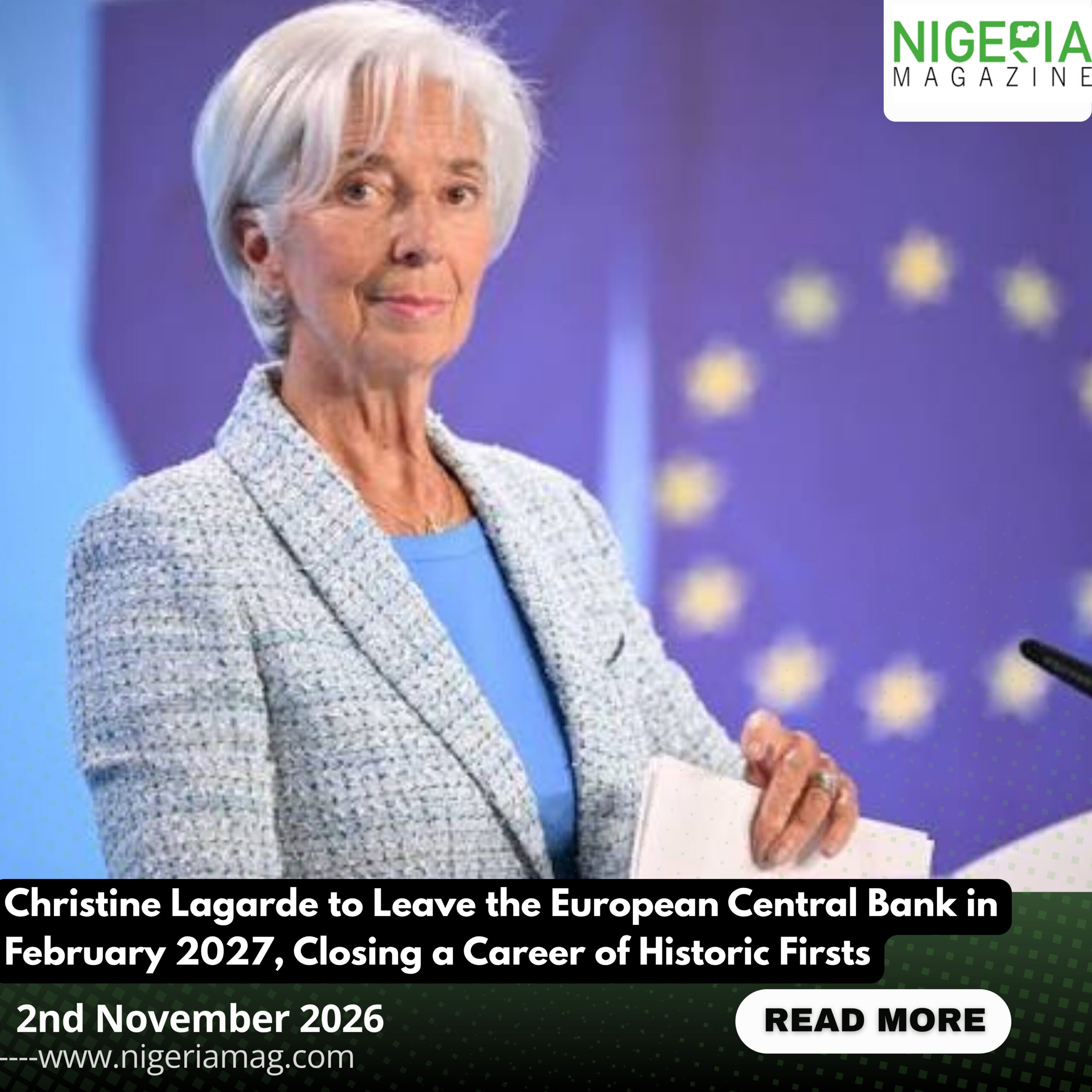
Christine Lagarde will step down as President of the European Central Bank on 7 February 2027, bringing her leadership of the institution to a close nearly nine months before her eight-year term was due to end on 31 October 2027.
The ECB confirmed the news on 29 October 2026, after Lagarde informed the Governing Council and European Council President António Costa of her decision. The Council responded with a long standing ovation. Her successor will be appointed by the European Council under the nomination process set out in the EU treaties.
The ECB’s statement gave no reason, but Lagarde addressed the question at the press conference that followed the bank’s decision to hold interest rates steady at 2.5 per cent. She said she wants greater freedom to speak on matters beyond monetary policy, explaining that central bankers must stay neutral as the price of their independence, and that she no longer feels comfortable in that position. She added that she would remain fully engaged until her departure and would lead the December and February monetary policy press conferences.
Her exit has been the subject of speculation for months, much of it tied to the timing of France’s presidential election in April 2027 and the question of who will choose her successor. Those theories remain unconfirmed. The reason Lagarde herself has given is the desire to speak more freely.
Lagarde’s career has been marked by breakthroughs for women at the highest levels of law, government and global finance.
She became the first woman to chair the international law firm Baker McKenzie, leading its global executive committee from 1999. In 2007, she became France’s Minister of the Economy, Finance and Industry, the first woman to hold that post in France and the first woman to serve as finance minister of any G7 country. In 2011, she was appointed Managing Director of the International Monetary Fund, the first woman to lead the institution. In 2019, she became the first woman to preside over the European Central Bank.
Her time at the ECB has coincided with some of the most testing years for the eurozone. She led the bank through the COVID-19 pandemic, a sharp surge in inflation and sustained geopolitical uncertainty, in rooms where decisions shape economies and affect millions of lives.
The race to succeed her has begun. The ECB’s chief economist, Philip Lane, is also due to leave at the end of his term in mid-2027, so the bank faces a wider change in leadership.
For women in Nigeria and across Africa, Lagarde’s journey is a reminder of what leadership can look like when old boundaries are challenged. She leaves the ECB with four historic firsts to her name and a career that has opened doors for those who follow.
#NigeriaMagazine

