


By Nigeria Magazine Desk
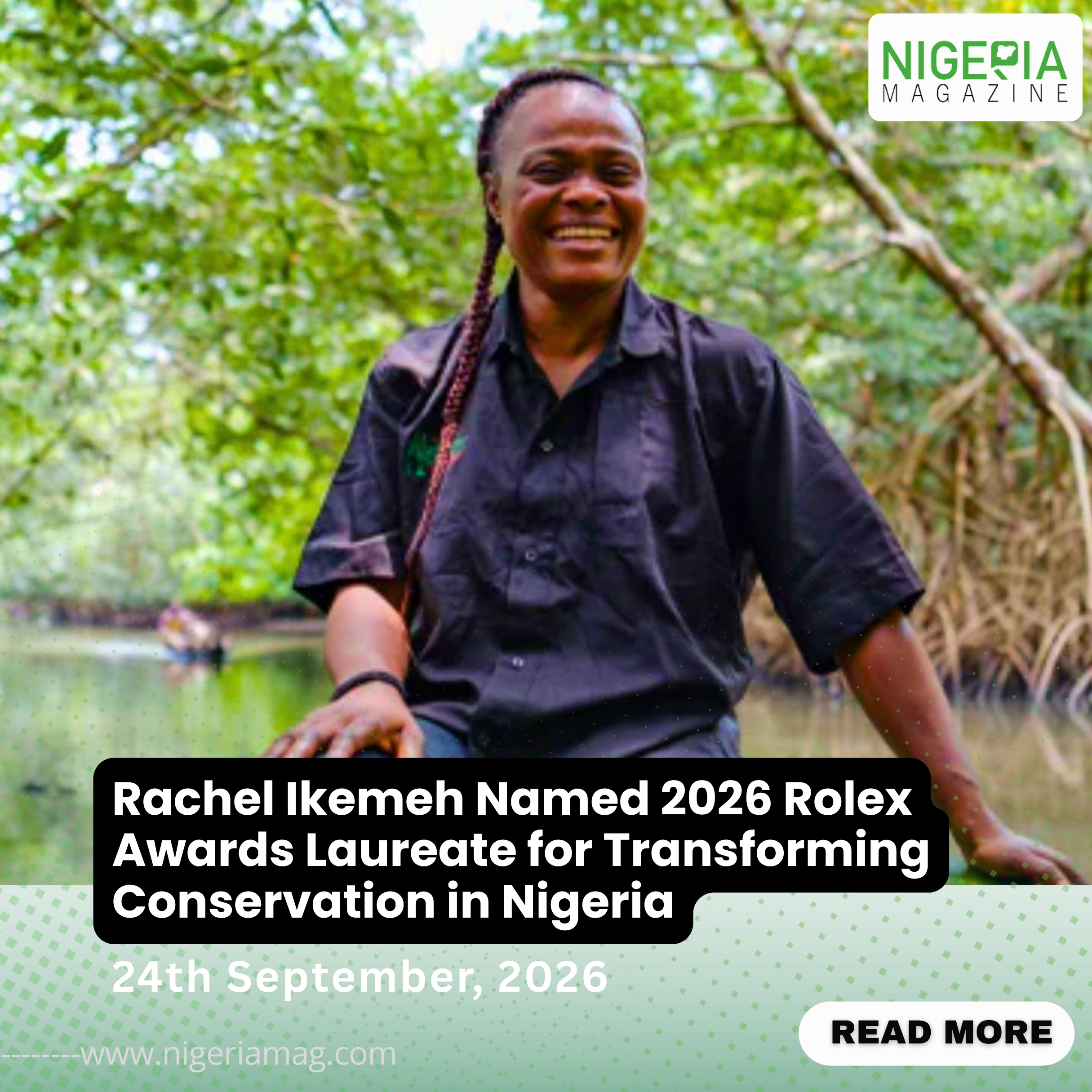
Nigerian conservationist Rachel Ikemeh has been named one of the five Laureates of the 2026 Rolex Awards, recognising her pioneering work in protecting biodiversity and empowering communities in the Niger Delta.
Ikemeh, founder of the South-West/Niger Delta Forest Project (SWNDFP), has spent more than two decades working to protect some of Nigeria’s most threatened forests and wildlife while creating opportunities for communities living within these ecosystems.
Her work has been particularly significant in the Niger Delta, a globally recognised biodiversity hotspot that is also at the centre of Nigeria’s oil industry.
The region is home to extensive mangrove and swamp forests and supports thousands of plant and animal species. However, decades of environmental degradation, including oil pollution and deforestation, have placed many of these ecosystems and the communities that depend on them under pressure.
Bringing Communities Into Conservation
Rather than approaching conservation as an effort imposed from outside, Ikemeh has developed a community-led model that places local people at the heart of protecting their environment.
One of the major milestones in her work came in 2021, when she helped establish a conservation area covering more than 1,000 hectares in partnership with the Apoi community.
The community took responsibility for protecting the forest, with the initiative producing significant ecological and social benefits.
The conservation programme now protects at least 13 threatened species, including the critically endangered Niger Delta red colobus monkey, a species Ikemeh is credited with helping bring back from the brink of extinction.
Other species benefiting from the conservation effort include the grey parrot, West African dwarf crocodile, white-bellied pangolin, Anambra waxbill, red-capped mangabey, Nigerian white-throated monkey and sitatunga.
The initiative has also helped replenish fishery resources and improve biodiversity within the mangrove habitat.
For local residents, the benefits have extended beyond environmental protection. The programme has supported employment, education, infrastructure development, environmental health initiatives and alternative livelihood opportunities.
Protecting More Than 10,000 Hectares
The success of the Apoi project has enabled Ikemeh and her organisation to expand the model to other parts of the Niger Delta.
The SWNDFP now operates four conservation areas covering more than 10,000 hectares of forest. According to Rolex, the initiative has improved at least 2,500 local livelihoods, while more than 18,000 people have participated in conservation education.
The broader Rolex profile of Ikemeh credits her work with protecting more than 5,839 hectares of forest and at least 13 threatened species, while improving the livelihoods of thousands of people.
A New Chapter for Niger Delta Conservation
The 2026 Rolex Award will support Ikemeh as she expands her community-led conservation model.
Her plans include establishing four additional community conservation areas, as well as creating a training hub and mobile education programme designed to equip local communities with practical conservation skills.
The programme will cover areas including project development, conservation planning, habitat management and sustainable livelihoods.
One of the new projects will take Ikemeh’s conservation work into a new area: marine conservation.
In Foropa, a community located along the Delta’s coast, she plans to establish what she describes as the region’s first marine protected area.
The initiative is expected to combine protection of the coastal ecosystem with opportunities for surrounding communities to develop sustainable livelihoods.
Inspiring the Next Generation
Beyond the forests and wildlife, Ikemeh’s work is also influencing how young people view conservation as a career and a means of creating change.
Reflecting on her more than 20 years in the field, she recalled a moment when a young boy from one of the communities pointed at her when asked what he wanted to become.
For Ikemeh, the moment represented a significant change from when she started her career, when conservation work of this nature was uncommon among young Nigerians, particularly women.
Her recognition as a 2026 Rolex Awards Laureate places her among five women from Nigeria, Indonesia, Peru, China and the United States selected for pioneering projects aimed at protecting the planet and improving lives.
The 2026 awards also mark the 50th anniversary of the Rolex Awards programme, which was established in 1976. Over five decades, the programme has supported 165 Laureates whose projects have contributed to environmental conservation, science, health, technology and exploration across more than 67 countries.
For Nigeria, Ikemeh’s recognition highlights the impact that locally driven conservation can have when communities are empowered to protect the ecosystems on which they depend.
Her next phase of work in the Niger Delta could further expand that model, connecting environmental protection, community development and conservation education across more communities in the region.

