


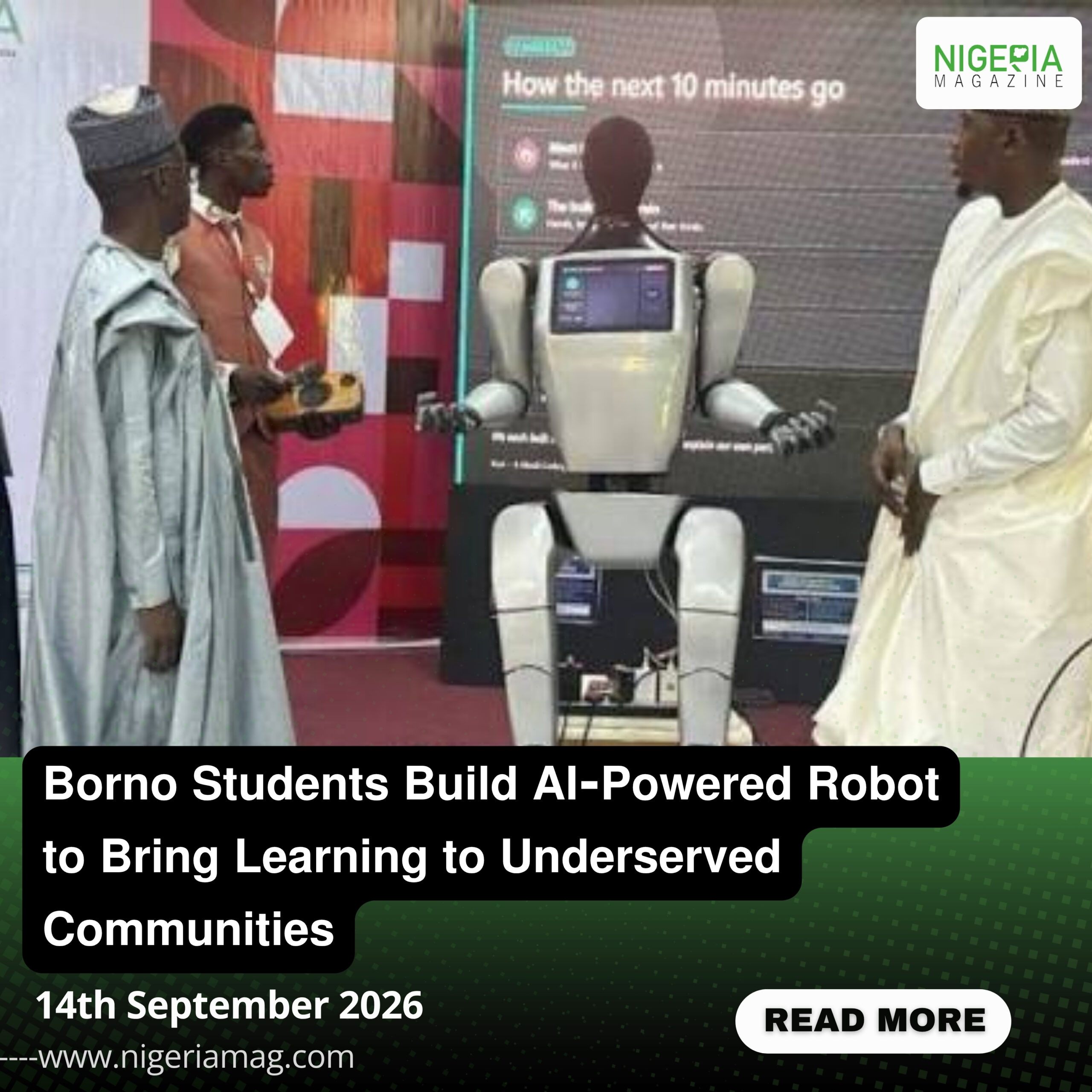
In a state where insecurity and teacher shortages have long disrupted education, a group of secondary school students in Borno has turned months of technical training into a working solution; a humanoid robot designed to help children learn where qualified teachers are scarce.
The robot, named Max Zulum in honour of Governor Babagana Umara Zulum, was unveiled in Maiduguri on August 4, 2026, at the graduation ceremony marking the end of the “Empowering Ideas, Empowering Communities” Artificial Intelligence Bootcamp and Data Analytics Fellowship. The six-month programme was organised by the Borno State Information and Communication Technology Development Agency (BICTDA) in partnership with local IT firm Maxzeeton Technology, and brought together students from six schools across the state for training in coding, programming, robotics, artificial intelligence, and data analytics.
Standing about 1.2 metres tall, Max Zulum is fitted with a chest-mounted display screen and a microphone-and-speaker system that allows it to interact with learners through voice. Its current capabilities centre on primary-level mathematics and science, where it can walk students through problems step by step rather than simply supplying answers; a deliberate design choice aimed at reinforcing understanding rather than shortcutting it.
One of the student developers behind the project explained that the robot’s interactive features were built specifically to support two-way engagement, letting children ask questions aloud and receive spoken explanations alongside the visual display. For the students, the robot represents the practical culmination of skills gained over the course of the fellowship; a shift from classroom instruction to independently engineering a functioning device.
BICTDA’s Executive Secretary described the initiative as part of the state government’s broader push to equip young people with digital skills that can translate into economic independence, calling the robot a meaningful first step that could pave the way for wider use of robotics across other sectors. Some of the students who took part also spoke about how the bootcamp reshaped their outlook, with one participant; who emerged as a competition winner during the programme; saying the experience motivated her to keep building in technology and to direct that skill toward solving problems in her own community.
Max Zulum remains a prototype and has not yet been rolled out as a deployed classroom tool. Even so, the project stands as a marker of what young innovators in Nigeria’s North East are capable of producing when given access to training, technology, and the room to experiment; turning a region often defined by its challenges into a source of homegrown solutions.

