


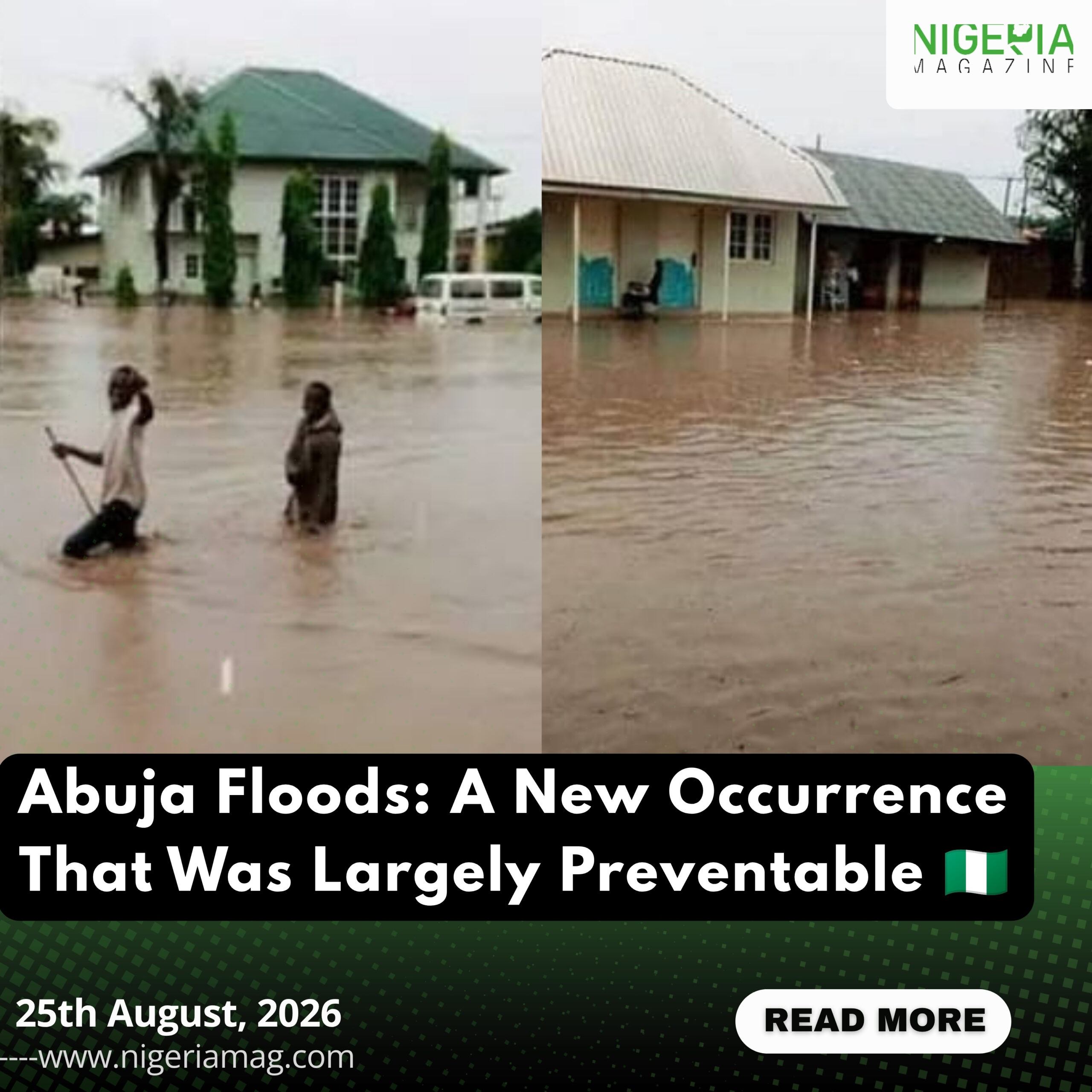
For many years, Abuja was regarded as Nigeria’s carefully planned capital, with flooding more commonly associated with rapidly developing areas such as Lugbe, Lokogoma and Trademore Estate. However, the heavy rainfall of August 15, 2026, which flooded major districts including Wuse II, Maitama, Gudu, Mabushi, Utako, Wuye, Asokoro, Gwarimpa and Lugbe, has raised concerns that the problem is now reaching the heart of the Federal Capital Territory.
While the heavy rain triggered the flooding, evidence from the Federal Ministry of Environment suggests that blocked manholes, drainage channels, accumulated silt, solid waste and debris significantly worsened the situation. The question, therefore, is not simply whether Abuja received too much rain, but whether the city was adequately prepared to manage it.
Rain Fell, But Human Actions Made the Flood Worse
The recent flooding has exposed long-standing problems with Abuja’s drainage and environmental management. When drains are blocked by refuse, silt and other debris, rainwater cannot flow freely, forcing it onto roads, homes and businesses. Poor maintenance of drainage infrastructure can therefore turn a heavy downpour into a major disaster.Construction on waterways, flood channels and drainage routes has also become a major concern. Following the flooding, FCT Minister Nyesom Wike said inspections had revealed developments obstructing designated water channels. The lesson is simple: when a city builds over the natural paths through which water flows, the water will eventually find another route. Abuja’s Master Plan and the Growing Risk Abuja was designed as a planned city, and its green areas, waterways and drainage corridors were part of that planning. However, rapid urbanisation and the expansion of buildings and paved surfaces have reduced the amount of open land available to absorb rainfall, increasing the volume of water flowing across the city during heavy storms.
Climate change may be contributing to more intense rainfall, but it should not become an excuse for poor planning and neglected infrastructure. The real challenge is whether Abuja’s drainage system, environmental protections and development controls can keep pace with the city’s rapid growth.
What Must Be Done?
Abuja needs more than emergency responses after every major rainfall. Major drainage channels must be regularly cleared and maintained, while government agencies should conduct a comprehensive audit of culverts, manholes and underground drainage systems.
The Abuja Master Plan must also be enforced, with further development on waterways and floodplains prevented. Green spaces, wetlands and other natural drainage systems should be protected rather than treated as vacant land for construction.Waste management must also become part of the flood-prevention strategy. Drains are not refuse bins, and stronger waste collection, public education and penalties for indiscriminate dumping are necessary. At the same time, ageing and undersized drainage infrastructure must be upgraded to meet the demands of a rapidly expanding capital.
The Bigger Lesson
The Abuja floods should serve as a warning that no part of the capital is immune when planning laws are ignored, drainage systems are neglected and natural water channels are obstructed. Heavy rain may have triggered the disaster, but blocked drains, waste accumulation, rapid urbanisation and poor development control appear to have made the consequences far worse.That is why much of Abuja’s flood problem is preventable.The solution is not simply to fight the water after it arrives, but to ensure that it has somewhere safe to go before the rain begins. Abuja was designed to be a planned city, and its future as a safe and resilient capital will depend on whether those principles of planning, environmental protection and infrastructure maintenance are taken seriously.The rains will continue. The real question is whether the failures that turn rain into disaster will continue too.Abuja must choose prevention over reaction, because when a city blocks nature’s pathways, nature eventually creates its own.
Ubong Usoro for Nigeria Magazine

