


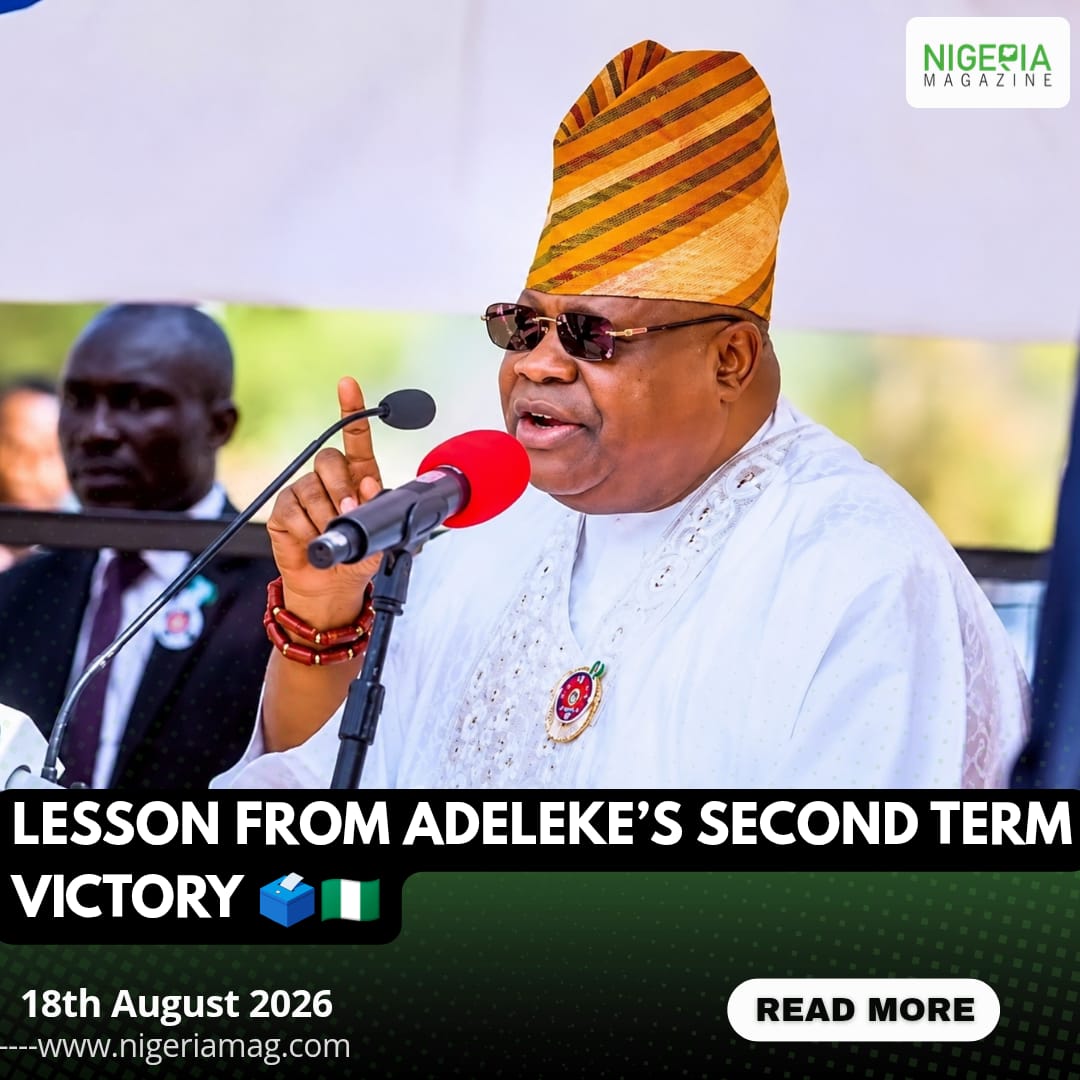
The re-election of Governor Ademola Adeleke in the August 15, 2026 Osun State governorship election offers more than a victory story for the Accord Party. It is a political case study in incumbency, voter mobilisation, grassroots organisation, performance messaging and the ability of a candidate to expand his electoral coalition.Adeleke was declared winner by the Independent National Electoral Commission after polling 511,067 votes, defeating the All Progressives Congress candidate, Bola Oyebamiji, who scored 444,815 votes. The margin was 66,252 votes.The governor won 19 of Osun State’s 30 local government areas, while Oyebamiji won 11. The African Democratic Congress candidate, Najeem Salaam, came a distant third with 17,180 votes.The numbers become even more significant when compared with Adeleke’s first victory in 2022.In that election, Adeleke, then running on the platform of the Peoples Democratic Party, defeated the incumbent APC governor, Gboyega Oyetola, with 403,371 votes against 375,027, a winning margin of just 28,344 votes.Four years later, Adeleke increased his personal vote from 403,371 to 511,067, gaining 107,696 additional votes, an increase of almost 27 per cent.His opponent also improved on the APC’s previous performance, with Oyebamiji polling 444,815 votes. But Adeleke’s expansion was greater, and his winning margin more than doubled, from 28,344 votes in 2022 to 66,252 votes in 2026.That is perhaps the first major lesson from the election:Winning once is not the same as building a political base. Adeleke’s second term victory suggests that his political organisation had grown beyond the coalition that first brought him to office.FROM 17 LGAs TO 19In 2022, Adeleke won 17 of the state’s 30 local government areas, compared with Oyetola’s 13. In 2026, he expanded that to 19, while the APC dropped to 11.The geographical spread matters.Adeleke did not rely solely on his traditional Ede base. He secured strong numbers in Ede North and Ede South, but also won Osogbo, the state capital, as well as Ife East, Iwo, Oriade, Egbedore, Ifelodun and other areas.In Ede North, Adeleke polled 35,427 votes against Oyebamiji’s 10,283. In Ede South, he scored 26,188 against 6,219. In Osogbo, he won 36,480 to 30,474.The lesson is straightforward: a candidate seeking re election cannot depend entirely on a home base. He must broaden the coalition.For political parties preparing for 2027, especially in states such as Akwa Ibom, the Osun experience demonstrates the importance of building structures beyond political strongholds.PERFORMANCE CAN BECOME AN ELECTORAL MESSAGEAdeleke’s campaign was not conducted in a political vacuum.His administration spent the four years between elections trying to create a record that could be presented to voters, particularly in workers’ welfare, infrastructure and education.Premium Times’ assessment of the administration found that residents who supported Adeleke frequently pointed to workers’ welfare, infrastructure and education, although others criticised the government over healthcare, security, tourism, investment and the distribution of infrastructure.The administration also announced a N159 billion infrastructure plan covering roads, health and education, while projects such as the Ila Orangun dual carriageway formed part of the infrastructure programme.Workers’ welfare was another important part of Adeleke’s political messaging. His administration repeatedly highlighted salary payments and the settlement of inherited arrears. The governor said his government had paid more than N80 billion in inherited pension debt and more than two thirds of inherited half salary arrears.Whether every government claim should be accepted without scrutiny is another matter. But electorally, the important point is that Adeleke had a tangible story to tell about what his government had done.That is a lesson for incumbents across Nigeria.A campaign based only on slogans, party identity and attacks on opponents may not be enough. Voters increasingly want to know: What changed in my community? What did your government deliver?THE POWER OF GRASSROOTS MOBILISATIONOsun also demonstrates that elections are ultimately won at the polling unit and local government levels.There were 2,339,544 registered voters for the 2026 election, but only 1,010,684 were accredited. Total votes cast stood at 1,005,800, with 985,079 valid votes and 20,721 rejected votes.That means only about 43 per cent of registered voters were accredited, while votes cast represented roughly 53 per cent of those who had collected their PVCs, according to reports based on the electorate eligible to vote.The implication is important.The winner is determined not by everyone who is eligible to vote, but by those who actually turn up and successfully cast their ballots.Adeleke’s campaign therefore needed more than popularity. It required voter mobilisation, election day organisation and the ability to translate support into actual votes across 30 LGAs.This is particularly relevant for 2027, when political parties will be fighting for millions of votes across Nigeria.THE APC’S DEFEAT ALSO CONTAINS A LESSONThe Osun election should not be analysed only from Adeleke’s perspective. The APC’s defeat is equally instructive.Oyebamiji actually scored more votes than Oyetola did in 2022, 444,815 compared with 375,027. Yet he still lost because Adeleke expanded his own vote even more dramatically.This means that an opposition party can improve its numerical performance and still lose an election if its opponent grows faster.The APC also faced the challenge of translating national power into state level electoral control.Osun voters were not simply voting for the party controlling the Federal Government. They were also judging the incumbent state government, the candidates, local structures and political relationships.The 2026 election was contested by 15 political parties, but the actual battle was overwhelmingly between Adeleke’s Accord and the APC. The ADC, despite the political expectations surrounding its candidate Najeem Salaam, could not win a single LGA.This demonstrates another reality of Nigerian politics:A crowded ballot does not necessarily produce a competitive three way race.Third party candidates require much more than visibility. They need structures, resources, credible local networks and the ability to convert public interest into votes.2027 AND THE QUESTION OF VOTER APATHYPerhaps the biggest lesson from Osun is the importance of turnout.The state had more than 2.33 million registered voters, but only about 1 million people were accredited in the governorship election.This is significant because Nigeria already has a serious voter participation problem.In the 2023 general election, national turnout was only about 27 per cent, despite Nigeria having more than 93 million registered voters.Osun’s experience therefore presents a paradox: the electorate can be large on paper while the actual voting population remains relatively small. For 2027, this could become decisive.If millions of Nigerians who are registered refuse to vote because of distrust, economic hardship, security concerns or frustration with politicians, elections could increasingly be determined by smaller groups of highly mobilised voters.In other words, voter apathy can become an electoral advantage for whoever has the strongest political machine.THE 2018 TO 2022 TO 2026 JOURNEYAdeleke’s political journey in Osun also offers one of Nigeria’s clearest examples of persistence.In 2018, he lost to Oyetola by only 482 votes after the supplementary election. Oyetola finished with 255,505 votes against Adeleke’s 255,023.Four years later, Adeleke returned and defeated Oyetola by 28,344 votes.Four years after that, he defeated the APC’s Oyebamiji by 66,252 votes.The progression is striking:2018: Adeleke loses by 482 votes.2022: Adeleke wins by 28,344 votes.2026: Adeleke wins by 66,252 votes.It tells a story of a politician who moved from a narrowly defeated candidate to a two time elected governor.But it also shows something deeper about Nigerian elections: political fortunes can change dramatically when candidates combine persistence, organisation, alliances and a message that resonates with voters.WHAT AKWA IBOM AND OTHER STATES CAN LEARNFor Akwa Ibom and other states heading toward 2027, the Osun lesson is not that Adeleke’s strategy can simply be copied.The deeper lesson is that elections are won before election day.They are won through years of building relationships with communities, understanding local grievances, delivering visible projects, maintaining political structures, communicating achievements and mobilising voters. And perhaps most importantly, incumbents should understand that voters are not permanently loyal. Adeleke himself defeated an incumbent in 2022. He has now become the incumbent who has successfully defended his mandate.The same electorate that removed one government can remove another.That is the essence of democracy.The 2026 Osun governorship election has therefore produced a clear message ahead of 2027:Political parties need more than candidates. They need structures. Governments need more than projects. They need results that citizens can see and feel. And voters need more than registration. They need confidence that their participation can change the direction of government. Adeleke’s second term victory is, ultimately, a lesson in the politics of performance, persistence, coalition building and mobilisation.But it is also a reminder to every incumbent across Nigeria:A first term victory gives you office. Only the voters can give you a second term.
Ubong Usoro for Nigeria Magazine

