


By Moses Chibuike Ezechukwu
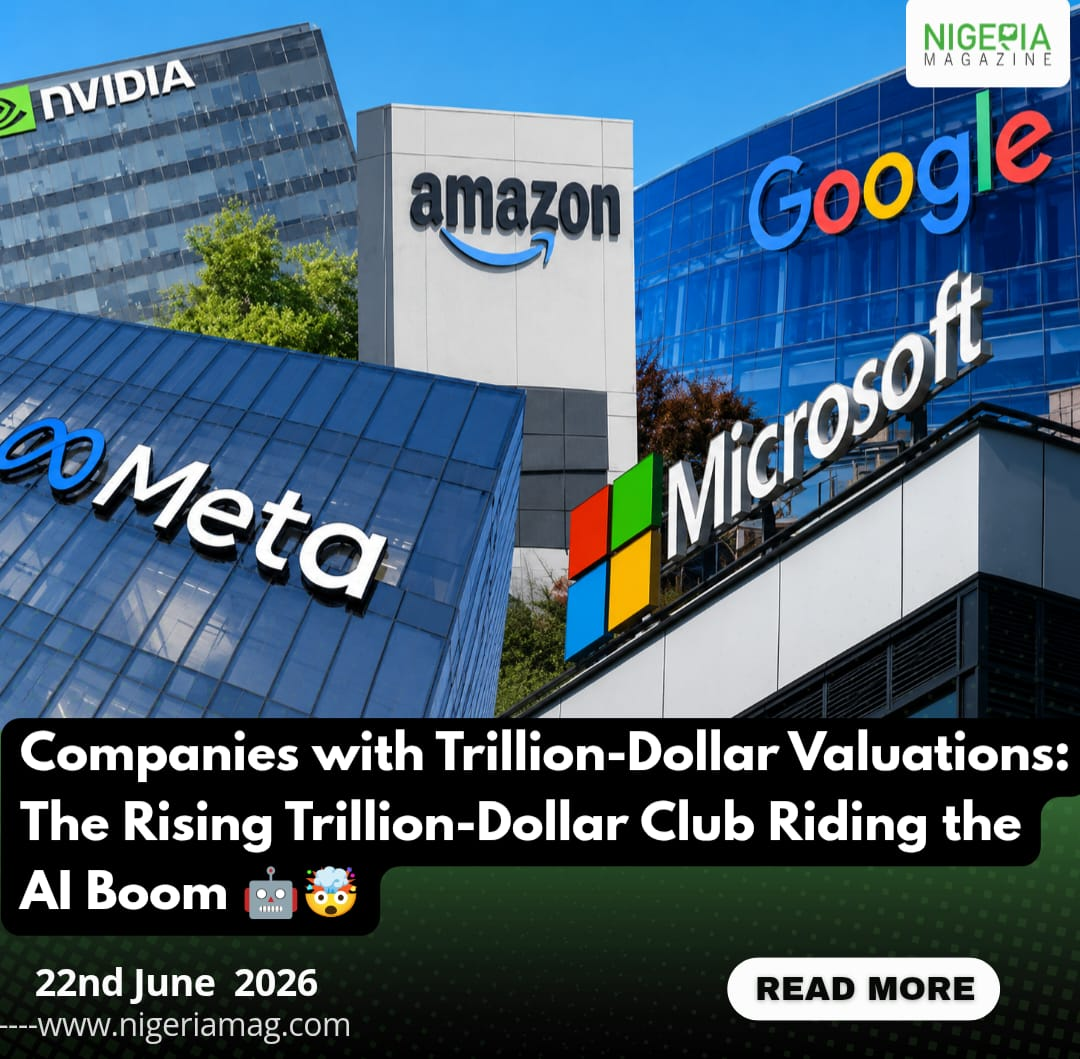
As artificial intelligence reshapes global industries at lightning speed, a small group of technology giants are pulling away from the rest, racing toward—and in some cases surpassing—the elusive trillion-dollar valuation mark.
If you told investors a decade ago that multiple companies would cross the trillion-dollar valuation line within a single generation, it would have sounded like fantasy. Yet here we are in an era where artificial intelligence is not just a buzzword but a full-scale economic engine, reshaping how companies grow, compete, and dominate global markets.
The “trillion-dollar club” is no longer a one-man show. It started with Apple, briefly joined by Microsoft and Saudi Aramco, but today the race is broader, faster, and deeply tied to the AI revolution. The question is no longer if companies will reach trillion-dollar status, but how many will get there—and who gets there next.
The New Economics of Scale: Why AI Changes Everything
At the centre of this transformation is artificial intelligence. Unlike previous technological shifts—like mobile phones or cloud computing—AI scales differently. Once built and trained, AI systems can be deployed across billions of users with minimal additional cost.
This creates what investors call “infinite margin potential.” Companies are no longer just selling software or devices; they are selling intelligence itself—embedded into search engines, productivity tools, cloud platforms, advertising systems, and even hardware chips.
As a result, valuation models have been rewritten in real time. Revenue is no longer the only metric that matters. Instead, investors are betting on:
Data dominance
AI infrastructure control
Cloud computing capacity
Chip manufacturing strength
Ecosystem lock-in
These factors have turned a handful of companies into near-unstoppable financial forces.
The Core Members of the Trillion-Dollar Club
Apple: The Silent Giant Holding Its Ground
Apple remains one of the most stable members of the trillion-dollar club. While it may not always lead the AI conversation, its ecosystem—iPhone, Mac, iCloud, App Store—creates a tightly locked user base that generates consistent revenue.
Apple’s approach to AI is more subtle. Instead of shouting about breakthroughs, it quietly integrates intelligence into its devices, focusing on user experience, privacy, and hardware-software synergy. This strategy keeps Apple firmly in the trillion-dollar category, even during market fluctuations.
Microsoft: The AI Powerhouse in Plain Sight
If there is one company that has aggressively positioned itself at the centre of the AI revolution, it is Microsoft. Through its partnership with OpenAI and deep integration of AI tools into products like Microsoft 365 and Azure, Microsoft has transformed itself from a traditional software company into an AI infrastructure leader.
Azure cloud services, in particular, are a major driver of valuation growth. Businesses worldwide are now dependent on Microsoft’s cloud backbone to run AI workloads. This puts Microsoft in a powerful position—not just as a participant in the AI boom, but as one of its architects.
Nvidia: The Unexpected Trillion-Dollar Engine
No company symbolises the AI boom better than Nvidia.
Originally known for gaming graphics cards, Nvidia has become the backbone of artificial intelligence. Its GPUs are essential for training large language models, powering data centres, and enabling AI computation at scale. As demand for AI skyrockets, so does demand for Nvidia chips. This has led to explosive revenue growth and a dramatic surge in valuation, pushing Nvidia firmly into the trillion-dollar conversation. In many ways, Nvidia is not just benefiting from the AI boom—it is enabling it.
Amazon: The Quiet Infrastructure Giant
Amazon’s trillion-dollar valuation story is rooted in its dominance of cloud computing through Amazon Web Services (AWS). While many people associate Amazon with online shopping, the real profit engine is AWS, which powers startups, governments, and multinational corporations.
As AI workloads increase, AWS becomes even more critical. Training AI models requires massive computing power, and Amazon provides that backbone. This makes Amazon a foundational player in the AI-driven economy.
Alphabet (Google): The AI Pioneer Reinventing Itself
Google, under Alphabet, was one of the earliest companies to invest heavily in artificial intelligence research. Today, that long-term strategy is paying off. From search algorithms to YouTube recommendations and Google Cloud AI services, Alphabet is deeply embedded in AI systems that billions of people use daily.
However, competition is intensifying. New AI-powered search alternatives and chat-based systems are challenging Google’s dominance. In response, Alphabet is rapidly integrating generative AI into its ecosystem to maintain its trillion-dollar status.
The New Contenders Eyeing the Trillion-Dollar Mark
Beyond the established giants, a new wave of companies is approaching trillion-dollar territory, fueled almost entirely by AI optimism.
Meta Platforms: Betting the Future on AI and the Metaverse
Meta has pivoted aggressively toward artificial intelligence, embedding AI into Facebook, Instagram, WhatsApp, and its advertising systems. Its open-source AI models have also gained global attention.
If its AI strategy continues to scale, Meta could re-enter or stabilise within the trillion-dollar club in the coming years.
Tesla: AI Beyond Cars
Tesla’s valuation is increasingly tied not just to electric vehicles but to its ambitions in autonomous driving and robotics. The company is positioning itself as an AI-first mobility and robotics firm, betting that self-driving technology and humanoid robots will define its next growth phase.
AI-Native Startups: The Wild Cards
While not yet at trillion-dollar scale, AI-native startups are growing faster than traditional tech companies ever did. Some investors believe that the first trillion-dollar startup of the AI era may not even exist yet—but is currently being built.
The Risks Behind the Boom
Despite the excitement, the trillion-dollar AI race is not without risks.
Overvaluation concerns – Markets may be pricing in unrealistic AI growth.
Regulatory pressure – Governments are beginning to scrutinise AI dominance.
Energy consumption – AI data centres require massive power resources.
Competition surge – Smaller, faster innovators can disrupt incumbents.
These risks mean that while the trillion-dollar club is expanding, it is also becoming more volatile.
The Future: A Club That May No Longer Be Exclusive
The trillion-dollar valuation was once a rare milestone. Today, it is becoming a benchmark for tech dominance. With AI accelerating productivity, revenue streams, and global dependency on digital infrastructure, more companies will likely cross the threshold in the next decade.
What used to be an exclusive club is turning into a competitive league.
And in this league, AI is the ultimate referee.
The trillion-dollar valuation club is no longer just about size—it is about influence over the future of intelligence itself. Companies that control AI infrastructure, data, and computation are shaping the next era of global economics.
As the AI boom continues to evolve, one thing is clear: we are only at the beginning of a much larger financial and technological transformation.

