


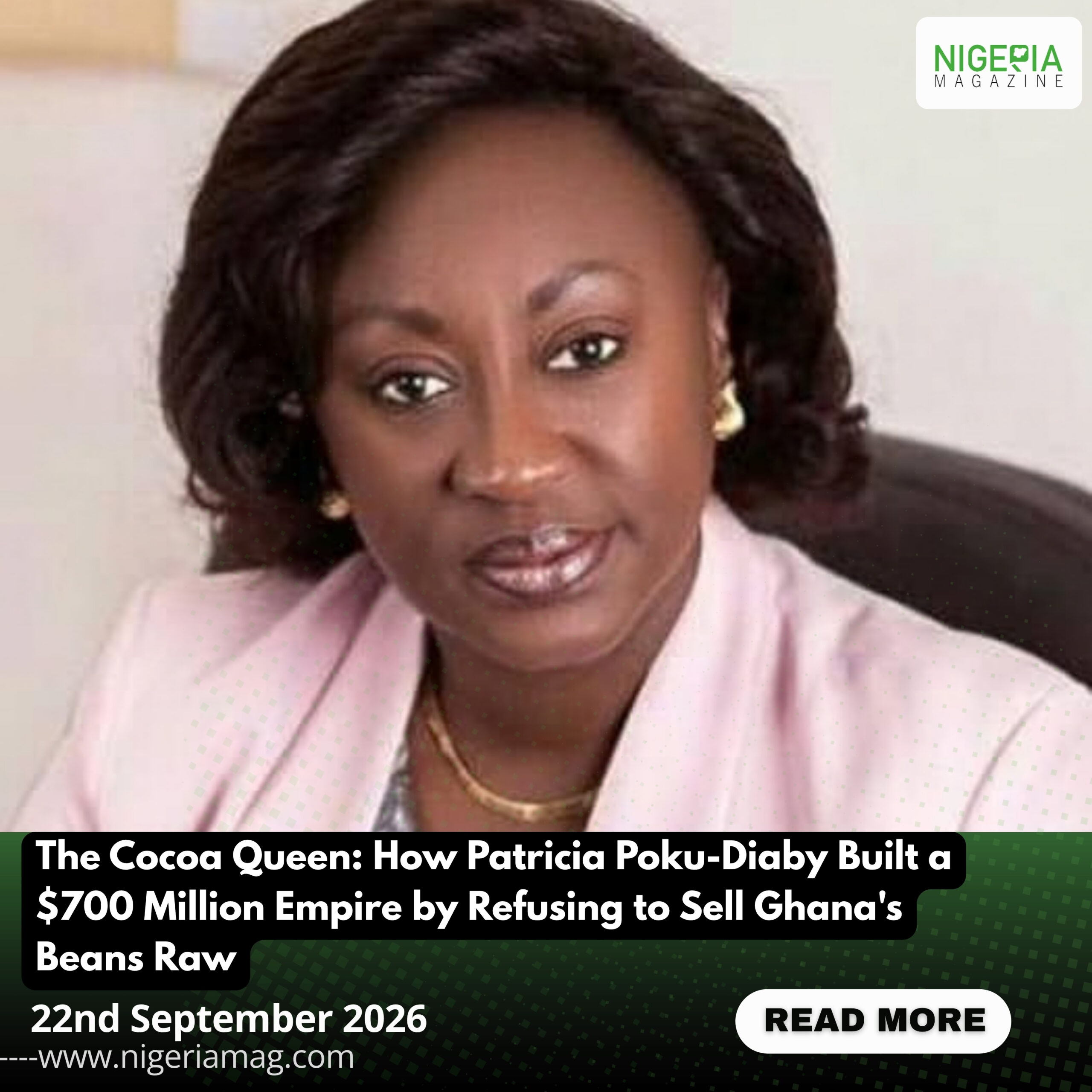
For decades, West Africa has produced roughly 70 percent of the world’s cocoa; the raw material behind a global chocolate industry worth more than $130 billion. Yet the profits from that industry have rarely stayed on African soil. The beans left. The value didn’t come back. Patricia Poku-Diaby looked at that imbalance and decided to build a different kind of business; one that would keep Ghana’s most valuable export working for Ghana.
Today, she is widely regarded as Ghana’s richest self-made businesswoman, with a fortune estimated between $400 million and over $700 million depending on the source, built almost entirely from a decision most exporters in her industry never made: process the cocoa at home, instead of shipping it away raw.
A childhood shaped by trade
Poku-Diaby’s story doesn’t begin in a boardroom. She was born into a family of 18 children, the daughter of Ghanaian entrepreneur Francis Kojo Poku, and grew up in Abidjan, Côte d’Ivoire, where she worked inside her father’s transport and trading company. It was there, moving goods across borders, that she learned how supply chains actually function; and, just as importantly, where value gets created or lost along the way. That early education would define the rest of her career.
Choosing the harder path
In 2010, she stepped out from the family business to found the Plot Enterprise Group, a commodities trading and processing company headquartered in Côte d’Ivoire before expanding into Ghana. She was entering an industry where multinational corporations had already built deep supply chains, manufacturing capacity, and global customer networks; the kind of terrain most new entrants avoid. Her approach was different: instead of exporting raw Ghanaian cocoa beans, she chose to process them locally, creating higher-value products and capturing more of the economic value before the beans ever left the country.
It made her the only African woman to build a large-scale cocoa processing facility, in an industry long dominated by men and multinational giants. Her plant in Takoradi, Ghana now processes 32,000 metric tons of cocoa annually, alongside a second, 16,000-metric-ton grinding facility in Abidjan.
The capital problem; and the partner who solved it
Building a cocoa-processing business, however, takes more than a factory. Processors must buy huge volumes of cocoa during harvest season, hold inventory, and finance production long before finished products are sold; a working-capital burden that has forced many promising local processors to stay small. That’s where Afreximbank entered the story. Through its Africa Cocoa Initiative, the bank provided Plot Enterprise with working-capital financing in 2016. The results were immediate: plant capacity utilisation jumped by 90 percent within a year. Poku-Diaby has called the partnership a genuine game-changer for her company.
Beyond cocoa
Her ambitions haven’t stopped at chocolate. She has since moved into mesofinance; a financing niche between microloans and traditional banking; through Innov Finances, a company she co-founded with Bintou Bayo, a former Banque Atlantique executive, aimed at supporting small and medium-sized enterprises that traditional lenders often overlook.
A model for the continent
Poku-Diaby’s rise is increasingly cited as a blueprint for a broader shift happening across African industry: pineapple processors in Ghana converting fruit into juices, cashew processors in Côte d’Ivoire moving into kernel production, textile manufacturers in Ethiopia working to capture more value from cotton. The underlying logic is the same everywhere it appears; keep more of the value chain at home, create more jobs, generate more export earnings, and build industries that outlast the commodity cycle.
Patricia Poku-Diaby simply arrived at that conclusion earlier than most; and built an empire proving it could work.

