


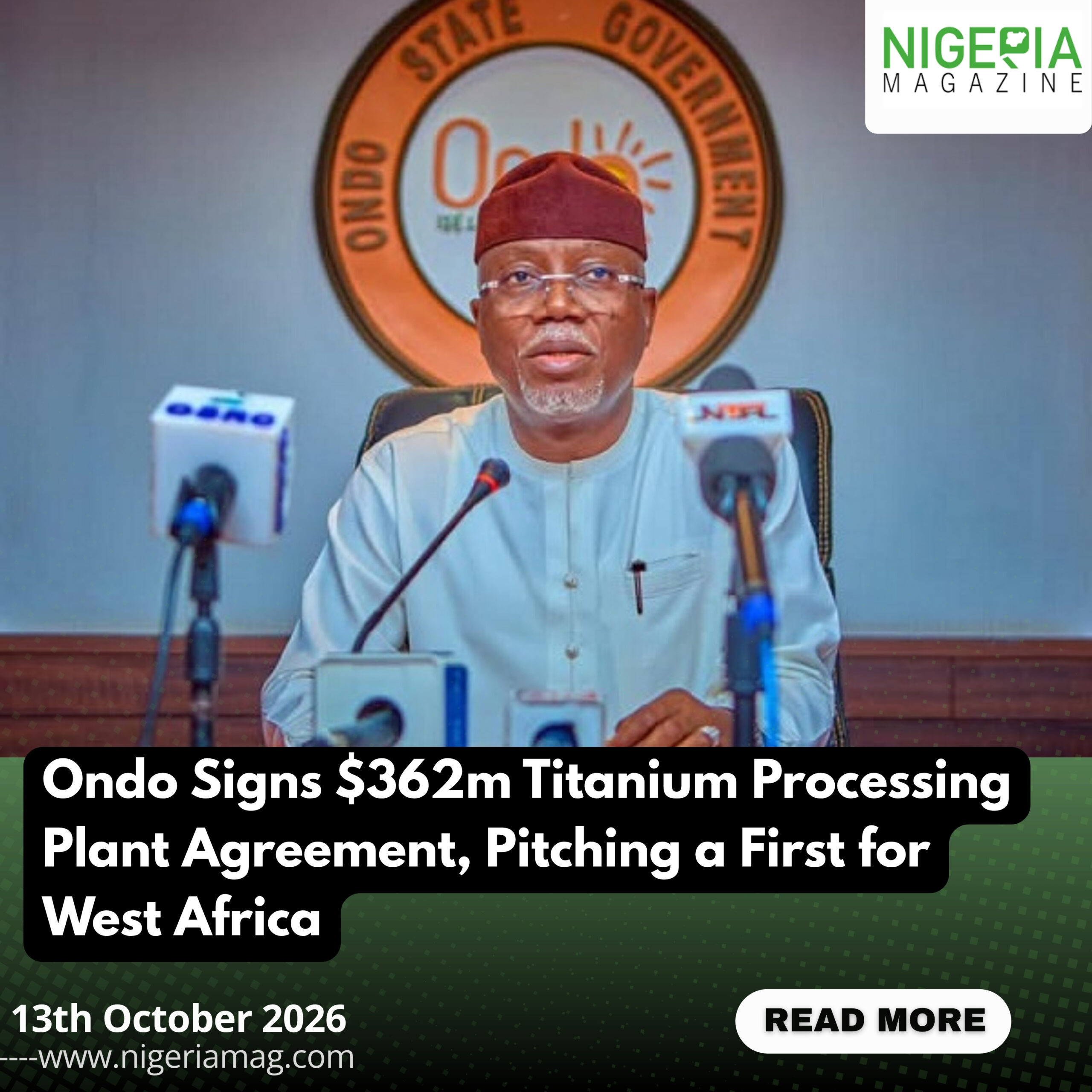
Ondo State has taken a formal step toward turning one of Nigeria’s raw mineral resources into finished industrial products at home. The state government has signed a public-private partnership agreement with PyVee Limited, a U.S.-linked chemical manufacturing company, to develop a titanium processing plant with an estimated total investment of $362 million.
The agreement was facilitated by the Ondo State Development and Investment Promotion Agency (ONDIPA) and signed in Akure, the state capital, under the administration of Governor Lucky Aiyedatiwa. Officials describe the planned facility as West Africa’s first and Africa’s second fully integrated titanium value-chain processing plant, which would also make it the first of its kind in Nigeria. It is to be sited in Ilaje Local Government Area.
The partnership will operate through a joint-venture company, PyVee Nigeria Titanium Limited, and the investment will be released in two phases. The first is a commercial pilot plant costing an estimated $12 million, which is targeted to become operational within 21 months. The second phase is a full-scale titanium processing complex. The $362 million figure is the projected capital outlay across both phases, not funds already committed.
The plant will be modular. A U.S. fabrication partner will build it and ship it to Nigeria for installation and commissioning.
The facility is designed to process ilmenite, a titanium-bearing ore Nigeria has in abundance, into titanium dioxide pigment and titanium sponge, instead of exporting the ore in raw form. The partners say the same chemical-processing platform could later support other strategic materials, including niobium-titanium alloys and selected rare earth products.
According to a statement by PyVee’s founder and chief executive, Dr Peter Oladipupo, the project is also meant to reduce dependence on imported titanium products and connect Nigeria to global aerospace and defence supply chains.
Supporters of the deal point to local value addition, job creation, foreign investment and import substitution. One report cites a projection of more than ₦480 billion in annual gross economic value nationally once the plant is running. The project could also open opportunities for local suppliers and businesses in construction, logistics and engineering.
These figures are projections, and the project is at the agreement stage. Whether it delivers will depend on whether the pilot plant is built and commissioned on schedule, whether the second-phase funding comes through, and whether the ore supply chain and the necessary infrastructure are in place in Ilaje. Ondo’s agreement does, however, add to the state’s growing list of industrial investment proposals. For a country long criticised for exporting raw materials and importing finished goods, a working titanium plant would be a meaningful shift.
If it succeeds, what other raw materials should Nigeria be processing at home?

